John Chapman — The Man They Left for Dead | Self Growth Videos


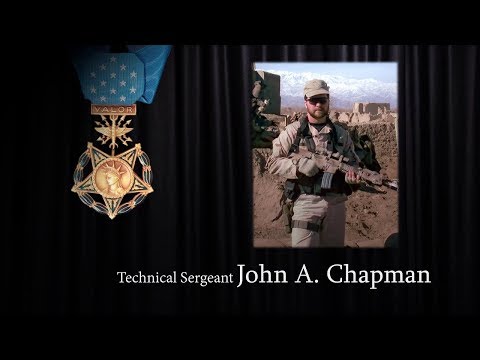


He was left for dead on a 10,000-foot mountain in Afghanistan, surrounded by al-Qaeda fighters, with no backup and no rescue coming.
His own team was gone. They believed he was dead.
He wasn’t.
What happened next — captured in full on Predator drone footage — is one of the most extraordinary acts of individual combat in the history of the United States military. And more than two decades later, the fight over how the country honors — or dishonors — John Chapman is still very much alive.
The Mountain. The Mission. The Man Left Behind.
March 4, 2002. Operation Anaconda. Shahi-Kot Valley, Afghanistan.
Air Force Technical Sergeant John A. Chapman was a Combat Control Technician — a CCT — attached to a SEAL Team Six element called Mako 30. Their mission: reach the summit of Takur Ghar after Navy SEAL Neil Roberts fell from a helicopter during a previous insertion attempt. Roberts was on that mountain. His team was going back for him.
The Chinook carrying Mako 30 flared to land on the summit and was immediately hit with a fusillade of RPGs and machine gun fire. During the chaos, Chapman exited the aircraft and moved directly toward the enemy. What he did next — in close quarters, at point-blank range, in knee-deep snow at 10,000 feet — earned him the Medal of Honor.
He charged a fortified enemy position. He killed the fighters inside. He fought forward into a second bunker. He was shot twice in the torso and went down.
His SEAL team leader, Master Chief Britt Slabinski, believed Chapman was dead. The team — carrying multiple wounded — retreated down the mountain.
John Chapman was alone.
He Was Still Alive.
This is where the story becomes something beyond war. Beyond courage. Beyond anything most of us have a framework for.
The Predator drone continued to record.
For over an hour after his team departed, John Chapman — mortally wounded, alone, in the dark on a frozen mountaintop surrounded by enemy fighters — got back up and kept fighting.
He engaged enemy combatants at a second bunker. He moved under fire. He fought hand-to-hand. He sustained shrapnel wounds, concussive blasts from American bombs his own team had called in overhead, and multiple gunshot wounds. The analysis of that footage would confirm he was alive and fighting the entire time.
When a Quick Reaction Force helicopter carrying Army Rangers approached the mountain at dawn, Chapman heard it coming. He knew what would happen — the same thing that had happened to the previous two helicopters. He made a decision.
He left cover.
He moved into the open to provide suppressive fire, drawing enemy attention to himself and away from the incoming aircraft. He was killed doing it.
His actions that morning are directly credited with saving more than 20 American lives.
Watch: The Ground Truth — AFO Commander Pete Blaber
This is the most comprehensive firsthand account of what happened at Takur Ghar from the man who commanded all Advanced Force Operations (AFO) elements during Operation Anaconda. Colonel Pete Blaber was 7 kilometers away that morning, on the radio, listening to chaos unfold in real time — chaos created not by the enemy, but by a disconnected chain of command a thousand miles away.
His account covers the full intelligence build that located the enemy in Shahi-Kot, the no-helicopter doctrine his teams operated under, and exactly what went wrong on the night of March 3rd — including audio recordings never heard publicly before.
Key points from Blaber’s account:
His AFO sniper-reconnaissance teams had been on the ground for weeks before the operation launched. They had built genuine intelligence, talked to shepherds, studied Soviet-era maps, and confirmed enemy presence through direct observation. They had a no-helicopter policy specifically because surprise was the only advantage against a dug-in, well-equipped enemy force in terrain that owned the high ground.
Mako 30 — the SEAL team Chapman was attached to — was rushed into the fight by a chain of command operating from Oman and Fort Bragg. They were not acclimated. They had not done the prep work. They were ordered in over Blaber’s explicit objections, in the dark, directly onto a hot objective, against the recommendation of every man who actually knew the battlefield.
“A junior officer made a decision about a mission he was unsure of, against an enemy he was unaware of, on a battlefield he had never stepped foot on,” Blaber said. “He had ignored the recommendation of the guy on the ground.”
The result was Roberts Ridge. The result was John Chapman fighting and dying alone.
Watch: The Controversy — What Chapman’s Family Wants You to Know
This is the other side of John Chapman’s story — not the mountain, but the long institutional war that followed. A war against his recognition. A war that, according to his family, continues today.
The core dispute: When Predator drone footage was finally analyzed in detail years after the battle, it proved beyond any reasonable question that Chapman was alive and fighting after Slabinski’s team departed. This had two direct consequences.
First: Chapman was posthumously upgraded from the Air Force Cross to the Medal of Honor in 2018 — the first airman to receive the award since Vietnam, and the first recipient in history whose heroic actions were verified entirely on video.
Second: The Navy simultaneously nominated Slabinski for the same upgrade — which he received months earlier than Chapman, despite the drone footage directly showing he had left a living teammate on the mountain.
Chapman’s sister, Lori Chapman Longfritz — who co-wrote the book Alone at Dawn that the upcoming Ron Howard film is based on — has been vocal for years about what she calls a systematic effort by Naval Special Warfare Command to suppress her brother’s story and protect Slabinski’s. The community that abandoned John Chapman has spent two decades trying to control the narrative about what happened on that mountain.
The Museum Fight: History Being Written by the Wrong People
In January 2025, a new chapter exploded into public view.
The National Medal of Honor Museum in Arlington, Texas was preparing to open. Chapman’s sister discovered that the museum — which had initially led her to believe her brother would receive a dedicated exhibit — had quietly reduced his presence to a photo at the entrance and a brief appearance in a video on the timeline of the award.
Slabinski, meanwhile, is among the museum’s featured exhibits — his section filled with personal artifacts including his field knife, ID tag, combat trousers and dress white uniform, and multiple photos. Slabinski also sits on the museum’s board of directors.
The family’s response was immediate and unequivocal.
“If both John and Slabinski had exhibits, and John’s was accurate, and Slabinski’s was accurate, then I would be fine,” Longfritz said. “If neither of them had an exhibit, I would be fine.”
Regarding the men who left her brother on the mountain, she drew a clear line: “I can’t judge them for what they did on the mountain, what happened. I can judge them for how they’ve acted since then.”
A petition demanding a dedicated Chapman exhibit gathered 25,000 signatures within weeks. The museum’s response was that not all 3,500-plus Medal of Honor recipients could receive equal floor space.
The museum spokesperson denied that Slabinski’s board position influenced his exhibit size. A museum official said both Chapman and Slabinski would be among the roughly 80 “in-depth” stories featured — with Chapman’s permanent place on the timeline to feature the video of his actions, noting he was the first recipient whose heroism was verified through drone footage.
Not everyone accepted that explanation. On July 14, 2025 — Chapman’s birthday — the museum failed to acknowledge him in the way it recognized other recipients’ anniversaries.
The Points of View: Where People Stand
This is not a simple story. Reasonable people who were there hold different positions. Here is where the major players stand.
Lori Chapman Longfritz (Chapman’s sister, co-author of Alone at Dawn): The Navy systematically worked to suppress her brother’s Medal of Honor upgrade because awarding it would constitute an official acknowledgment that a living American was left behind on that mountain. She has described the sequence of events leading to both men receiving the Medal of Honor as driven by politics, not merit. She has not forgiven the institutional behavior — not the fog-of-war decision on the mountain, but everything that followed.
Britt Slabinski: In a 2018 Fox News interview, Slabinski maintained: “I can tell you, we left no one behind. No one. What I saw, what I experienced, I know that clearly that we didn’t leave anyone behind up there.” In a 2016 New York Times interview, however, Slabinski acknowledged he “might have made a mistake under intense fire” and said he was “still haunted by what happened on the mountain.” He has publicly credited Chapman with saving his team’s lives and attended Chapman’s Medal of Honor ceremony in 2018.
Pete Blaber (AFO Commander): His position is the clearest of all, and it sidesteps the inter-service argument entirely. The men who died on that mountain — Chapman, Roberts, and the Rangers in the second helicopter — died because of decisions made by people who were not on the battlefield, who did not understand the battlefield, and who overrode the explicit warnings of the men who did. The fog of war on the summit is real. The decisions made from Oman and Fort Bragg are inexcusable. Those are two separate things.
The Air Force: Has consistently supported Chapman’s recognition and pushed back against the narrative that his actions were ambiguous or unclear. The drone footage is not ambiguous.
Naval Special Warfare Command: In a statement, said it holds Chapman “in high regard as a hero who made the ultimate sacrifice for his teammates.” The statement did not address past opposition to his Medal of Honor upgrade.
The Movie: Alone at Dawn
Ron Howard is directing Alone at Dawn, an adaptation of the nonfiction book by Dan Schilling and Lori Chapman Longfritz. The film stars Adam Driver as John Chapman and Anne Hathaway as the intelligence officer who campaigned to secure Chapman’s Medal of Honor. Filming took place in Maryland and Budapest between November 2025 and February 2026.
There is no set release date, but the film is likely to arrive no earlier than late 2026. It will be released theatrically before streaming on Amazon MGM.
The screenplay went through multiple drafts, with Dan Schilling — a combat control veteran himself and the man most responsible for bringing Chapman’s story to public attention — serving as a military consultant. Chapman’s sister Lori co-wrote the source book.
The casting of Driver — a former U.S. Marine — has drawn broad support from the military community. The choice of Howard, whose credits include Black Hawk Down collaborator-era prestige filmmaking and real-life drama (Frost/Nixon, Apollo 13, Rush), signals serious intent.
This film has the potential to do for John Chapman what Black Hawk Down did for Roberts Ridge awareness — bring the full weight of what actually happened to an audience of tens of millions. And unlike that film, this one has the drone footage. The truth is already on tape. The movie just has to show it.
Who Was John Chapman
Behind the Medal of Honor, behind the controversy, behind the footage — there was a man.
John Allan Chapman was born July 14, 1965, in Springfield, Massachusetts. He grew up in Windsor Locks, Connecticut. He enlisted in the Air Force in 1985. He became a Combat Control Technician — one of the most demanding special operations pipelines in the U.S. military, requiring mastery of airspace control, close air support, combat diving, military freefall, and direct action.
He was 36 years old when he died on that mountain.
He left behind a wife, Valerie, and two daughters.
His sister Lori has spent more than two decades ensuring the record is accurate. His mother Terri has lived with the knowledge that her son was left to die alone, and that the institution he served spent years trying to minimize what he did.
The creed says no man left behind. John Chapman is the test of whether that creed means anything at all.
Related Heroes
You Might Also Enjoy
Michael Murphy — The Phone Call That Cost Everything | Self Growth Videos
Explore →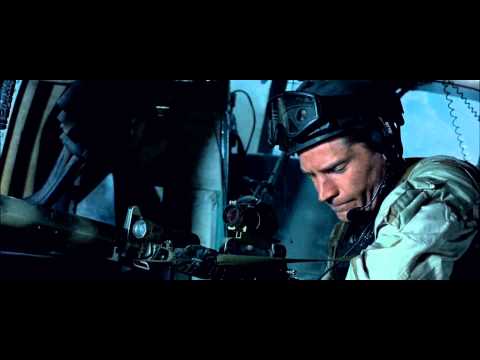
Gary Gordon & Randy Shughart
Explore →
Neil C. Roberts
Explore →