Arnold Schwarzenegger: Offer One Useful Contribution
How do I identify one useful contribution I can offer?
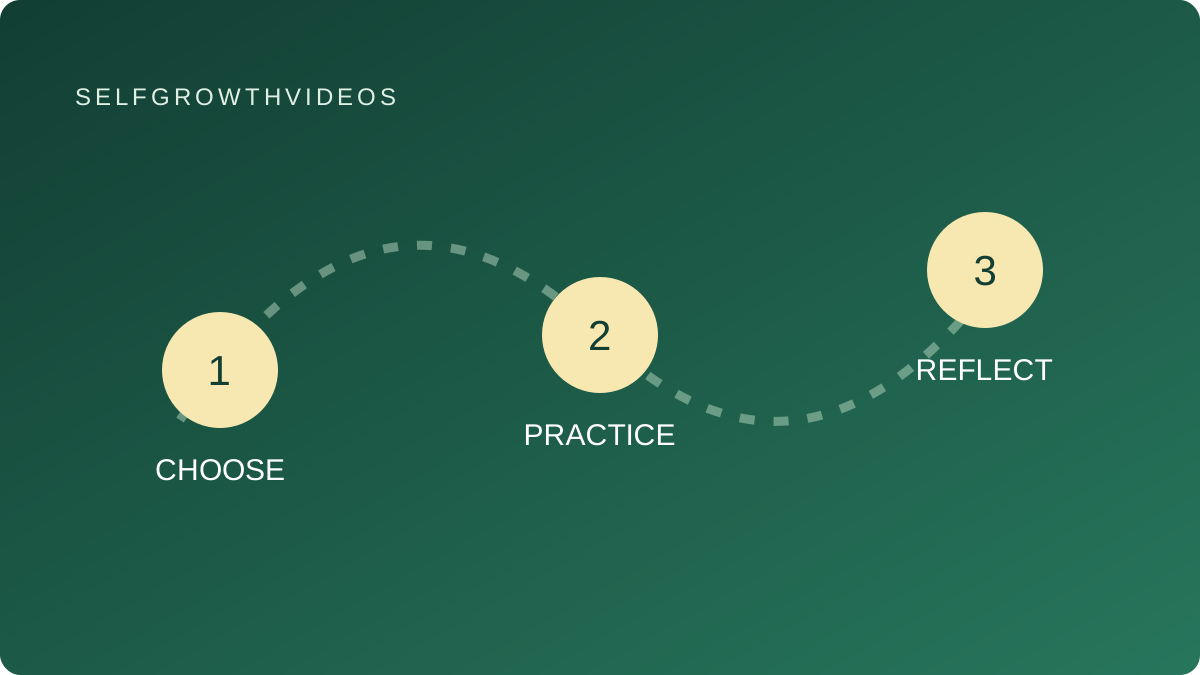 Choose, practice, reflect
A practical service exercise
The Lesson
You want to contribute to a group, but “I’d love to help” leaves everyone with another decision to make. The group may need a particular task completed at a particular time. A useful offer connects something you can do with a need the people involved actually recognize.
Arnold Schwarzenegger makes giving back part of his philosophy. In the published transcript of his conversation with Dimensional, he describes the help he received from collaborators and mentors, connecting that recognition with helping others in turn. His official summary of his 2017 University of Houston commencement address makes the same connection. The publisher of Be Useful: Seven Tools for Life also identifies giving back as a theme of the book.
Apply that invitation at an ordinary scale. You do not need a public platform to contribute to a study group, neighborhood activity, or community event. You might be able to explain a familiar process, prepare materials, or finish a small task that other work depends on.
Start by distinguishing a stated need from your guess. A group preparing a book swap may need somebody to label tables. You may prefer designing a new logo. Both involve effort, but only one may address the work that is currently waiting. Ask what is needed before assuming that the contribution you most enjoy is the most useful one.
A contribution also has conditions. Consider the skill involved, the time available, and any instructions or equipment you need. Saying what you can reliably offer helps people decide whether it fits. A small completed task can be a meaningful contribution in its own right.
Reflection
- Where am I already connected to a group or shared activity?
- What need has somebody actually expressed?
- What can I offer competently with my current time and resources?
- Would my idea reduce the group’s work, or create another project for them to manage?
If you do not yet know the need, your first step is learning about it. That inquiry is different from committing to take it on.
Practice
This is an original SelfGrowthVideos exercise, not Schwarzenegger’s prescribed worksheet or an endorsed volunteer program.
Choose one group you already know or one appropriate public volunteer opportunity. Read any current task description or participation instructions. Do not assume that an organization can accommodate an unsolicited project.
Make two short lists: Needs I have confirmed and Things I can reliably offer. Look for a match. If a need is only your interpretation, write a question beside it rather than treating it as confirmed.
For a hypothetical book swap, the match might be preparing table labels from an organizer’s approved categories. Your contribution could use a skill you already have, such as writing clearly or laying out a simple document. The organizer still needs to confirm the categories and whether labels are wanted.
Draft an offer with four details:
- The task you propose to complete.
- When and how much you can contribute.
- The information or resource you would need.
- A question that leaves room for a different answer.
For example: “I can prepare the table labels on Thursday evening using the categories you approve. I would need the list by Wednesday. Would that help, or is another task more pressing?”
If the offer is accepted, agree on what finished work should look like and how to deliver it. Keep the scope small enough to honor. If the answer is no, you can ask about another suitable need or leave the offer there. The group’s decision does not determine your value as a person.
Complete the agreed task, or communicate promptly if a condition changes. Before expanding the work, ask whether the extra contribution is wanted. A useful offer respects the people already responsible for the activity.
Review
Afterward, check whether you delivered what was agreed. Ask a focused question such as, “Were the labels usable as prepared, or did something need changing?” Record the answer without speaking for everybody involved.
What did you learn about the group’s needs and your own capacity? Decide whether to repeat the task, learn another skill, or offer something different next time. Let that decision follow the actual experience of contributing.
Go Deeper
Explore Arnold Schwarzenegger’s teacher profile. To clarify an accepted commitment, try Iyanla Vanzant: Clarify Your Part in a Shared Responsibility. To learn from help you have witnessed, use Mark Victor Hansen: Record a True Story of Service.