David Goggins: Describe Your Project Contribution Accurately
How can I describe my contribution without exaggerating or dismissing it?
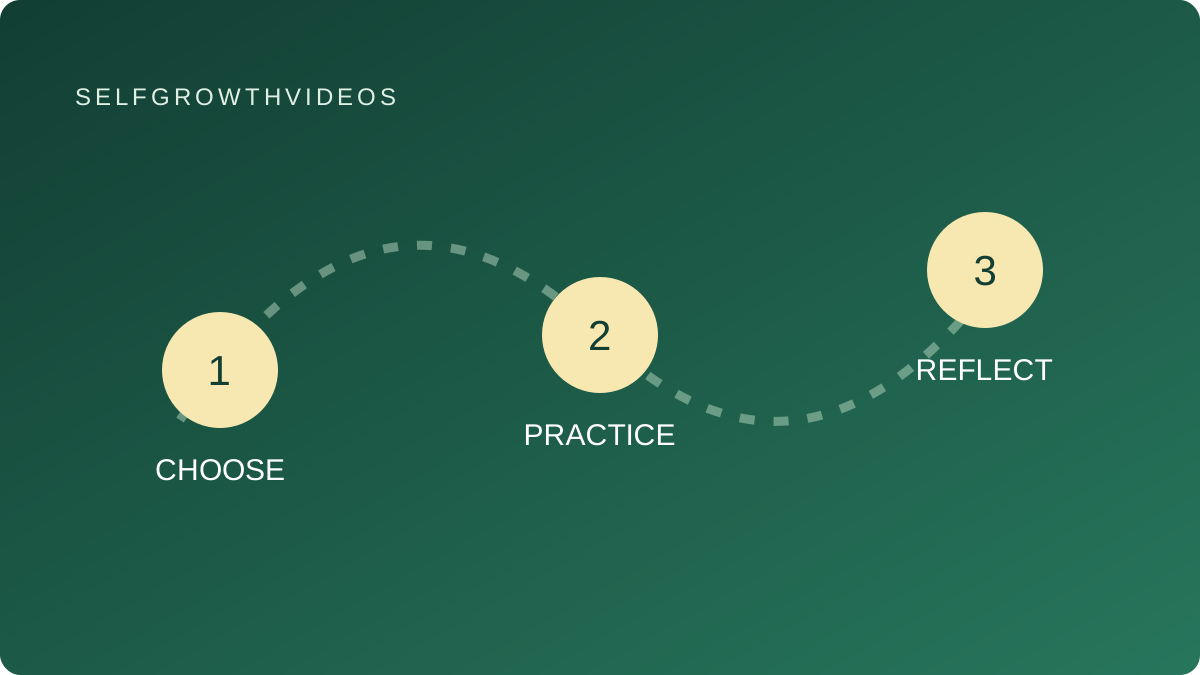 Choose, practice, reflect
An accurate contribution exercise
The Lesson
You helped finish a group project. Now a portfolio, application, or conversation calls for a description of your work. “I made the whole thing happen” feels too broad. “I just helped” leaves out something real. An accurate account can name both your contribution and its limits.
In the published transcript of his Huberman Lab interview, David Goggins emphasizes matching what he says about himself with work he has actually done. His official book page identifies Can’t Hurt Me and Never Finished as his memoirs. Here, we take the narrow idea of honest self-description into an ordinary project.
Start with a verb that fits your role. Drafted, checked, organized, revised, demonstrated, and assisted describe different actions. Choosing one asks you to remember what you actually did. It does not require making your contribution sound larger or smaller than it was.
Suppose a study group produced a presentation. You collected examples, drafted two slides, and corrected the reference list. A teammate chose the argument and delivered the talk. “Created and presented the group presentation” would blur those roles. “Collected examples, drafted two slides, and checked references for a group presentation” identifies work another person could recognize.
Separate the shared result from your own action. The group may have finished on time, but that does not establish that one person’s contribution caused the result. You can write what the team completed and then state the part you handled. If someone else substantially revised your draft, give that fact its place too.
An intention needs different wording from completed work. “I plan to learn the editing software” describes a next step. “I edited the recording” describes an action already taken. Both can belong in your notes, under their proper headings. A task you attempted but did not finish can still show what you tried and what remains to learn.
Use available evidence to check the description: a draft, task list, revision history, or agreed division of work. Evidence may be incomplete. When you cannot establish a detail, narrow the sentence or leave the uncertainty visible. Accuracy does not depend on producing a grand claim.
Reflection
- Which part of the project did I directly handle?
- Am I claiming a team result as if I produced it alone?
- Have I minimized work that was actually useful?
- Which sentence describes an intention rather than a completed action?
Think of a specific reader. A future collaborator may need to understand your experience more than they need an impressive slogan.
Practice
This is an original SelfGrowthVideos exercise. It is not a method prescribed by Goggins and does not imply his endorsement.
Choose one completed or partly completed project. Keep this first version private. Write four short notes:
- My actions: Name two or three things you actually did, using precise verbs.
- Other contributions: Identify work by teammates, tools, or sources that your description should acknowledge.
- Evidence and limits: Note what supports your account and anything you cannot yet verify.
- Next learning: Name a skill or task you intend to develop, clearly separate from past work.
Turn the first three notes into a short project description. For example: “Our group produced a guide for new volunteers. I drafted the arrival instructions and tested them with one volunteer. Another organizer revised the final layout. We have not yet checked whether the guide works for every role.”
Read each verb again. Could you point to the action it describes? Does “led” really describe your role, or would “coordinated the first meeting” be more accurate? Do not invent percentages or impact figures to make the sentence look stronger.
If a factual detail needs confirmation, ask an involved person a narrow question before publishing the description. Remove private information that you do not have permission to share.
Review
Return to the description when you next use it. Did a reader understand your role? Did a teammate supply a correction? Revise the account when new information warrants it.
Keep the separate learning note. Completing that next task later gives you something new to describe; it does not need to be claimed in advance.
Go Deeper
Explore David Goggins’ teacher profile. For a conversation about what belongs to each person, try Iyanla Vanzant: Clarify a Shared Responsibility. To identify a contribution you could make next, see Arnold Schwarzenegger: Offer One Useful Contribution.