Eliud Kipchoge: Write Observations Someone Else Can Use
What should I write down so someone else can understand a problem in my practice?
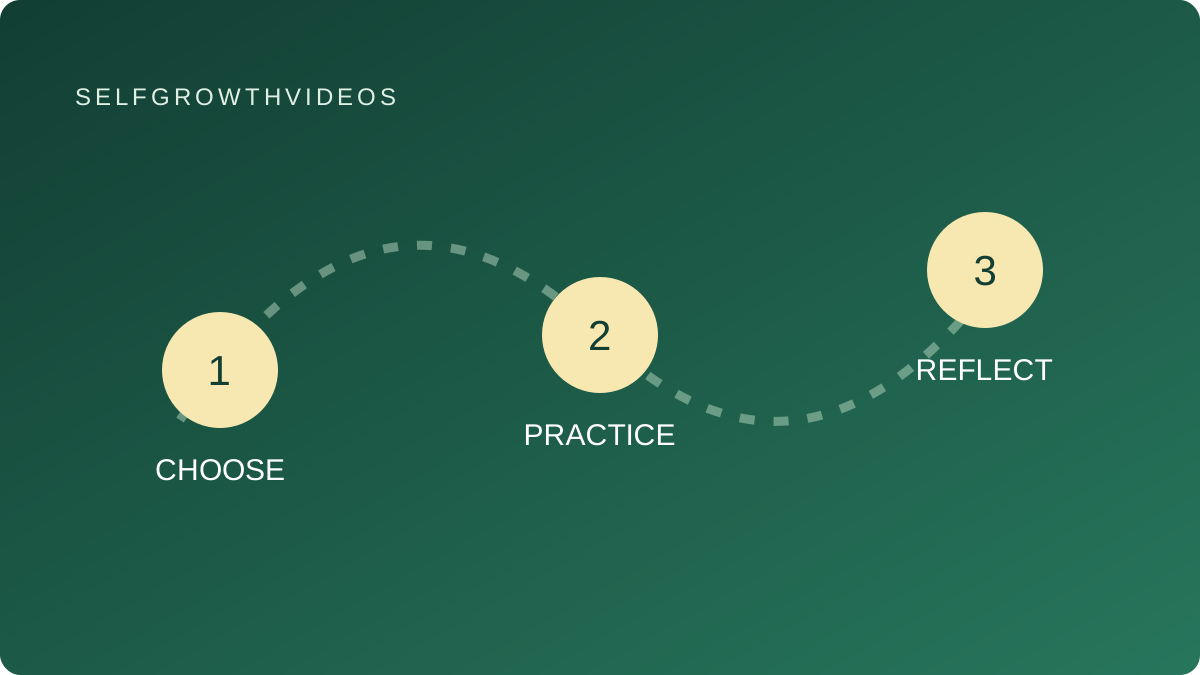 Choose, practice, reflect
A shared observation exercise
The Lesson
You ask a teacher or collaborator for help: “It isn’t working.” They want to help, but they do not know what you tried or where the difficulty appeared. A short observation note can give the conversation a concrete starting point.
Nike’s account of developing a running top with Eliud Kipchoge describes his handwritten observations and contextual training notes. It reports that designers changed the garment in response to his feedback, including adjusting its fit. This is Nike’s account of its own product work. Kipchoge’s official foundation site provides his background and describes its education and environmental mission.
The transferable idea is modest: another person needs enough context to understand an observation. You can use that idea while practicing a presentation, learning a tool, or trying a craft. You do not need an elite training routine or a new product to begin.
An observation note answers three different questions. What were the conditions? What did I do? What did I notice? A fourth question then asks what another person could help you understand.
Imagine practicing instructions for a short workshop. “My explanation was confusing” is a conclusion. A more useful note might say: “I explained the first step without showing the sample. My practice partner asked which file to open. After I showed the sample, they could identify the file.” That account gives a collaborator something specific to examine.
Keep an observation separate from its possible explanation. You noticed a question about the file. You suspect that showing the sample earlier might help. The suspicion is worth exploring, but the note should not silently turn it into a proven cause. Your partner may have been missing information you had not considered.
Include only context relevant to the question. The version of a document or the instructions used may matter. A lengthy account of the entire day may bury the detail. When useful and permitted, attach the exact example or point to the relevant passage so the other person can inspect it.
Reflection
- What would someone who was not there need to know?
- Which part of my note reports an observation, and which part guesses a cause?
- Can I point to the moment or example behind my question?
- What kind of response would be useful: clarification, demonstration, or a suggestion to test?
Ask about one manageable difficulty. A request to evaluate your entire ability is harder to answer from one example.
Practice
This is an original SelfGrowthVideos exercise. It is not Kipchoge’s prescribed practice log and does not imply his endorsement.
Choose one ordinary practice attempt you can describe accurately. Write a note with these headings:
- Context: The task, material, and relevant conditions.
- Action: What you actually tried.
- Observation: What happened that you could describe to another person.
- Question: One thing you want help understanding.
Here is a hypothetical example: “I practiced the opening of a workshop using version two of the handout. I explained step one before showing the example. My partner asked which file to open. Would you look at that instruction and tell me what information is missing?”
Read the note as if you were receiving it. Replace vague words such as “bad” or “weird” with the particular detail you mean. If you cannot remember what happened, say so; do not fill the gap with a confident reconstruction.
Ask whether someone has time to consider the note. Share only material you are allowed to share. If they suggest a change, write it under a separate heading, Suggestion to consider, so it remains distinct from your original observation. Agree on any next attempt that affects their time or work.
Review
After the conversation, check whether the note helped the other person locate the difficulty. What did they need to ask before they could respond? That missing context is worth including next time.
If you make another attempt, add a dated observation rather than rewriting the first one to match the new result. You can then see what changed and what remains uncertain without pretending one attempt proves the explanation.
Go Deeper
Explore Eliud Kipchoge’s teacher profile. To frame the request around a specific project, try Brené Brown: Ask for Useful Project Feedback. For reviewing an attempt on your own, see Serena Williams: Review a Learning Attempt.