Greg Isenberg: Find the Work Before Building an AI App
How can I turn an interesting AI business idea into a small problem I can actually investigate?
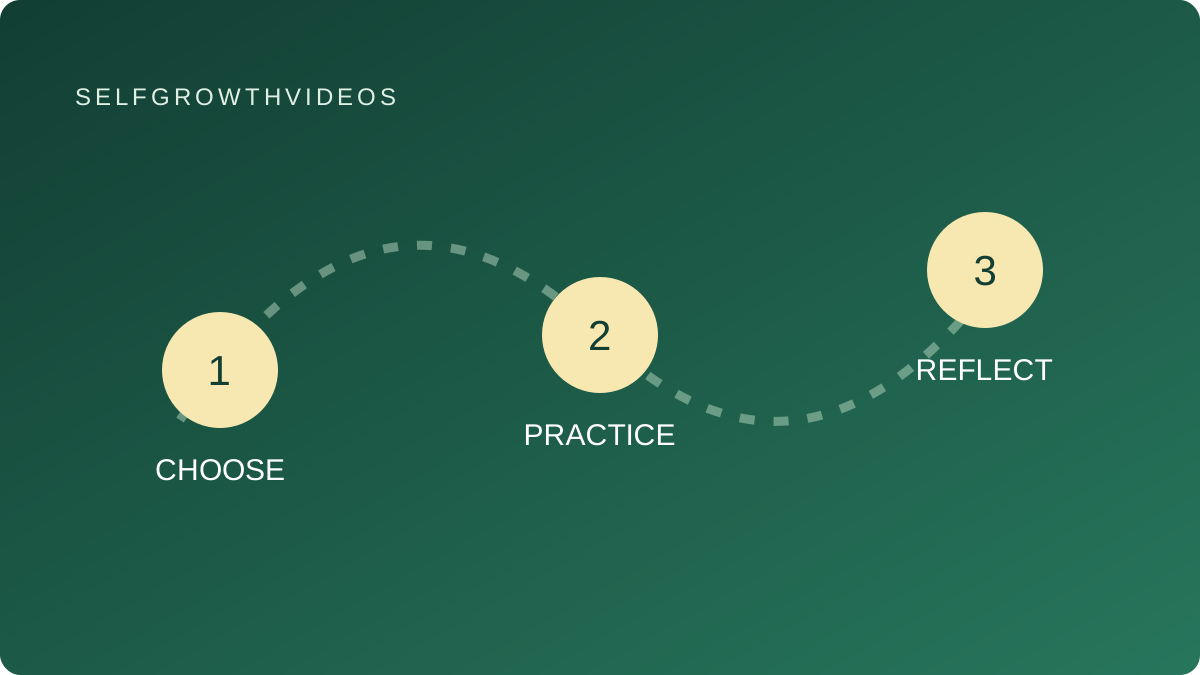 Choose, practice, reflect
A practical learning exercise
The Lesson
An AI app idea can sound exciting before you know which piece of work it would improve. “An assistant for small businesses” is a broad possibility. “Help a workshop organizer prepare a materials list from confirmed registrations” names something you can inspect.
In his June 2025 article, Greg Isenberg suggests looking for startup ideas in repeated prompts, copying between tools and recurring work. These are places to observe friction. Finding friction still leaves a question: does a particular person need the proposed change enough to use it? The exercise below is our way of investigating that question, rather than a claim that an idea is commercially validated.
Begin with a recent instance of work. What started it? What did the person receive? What did they produce? A description such as “administration takes too long” hides several different tasks. Preparing a materials list, checking a registration and replying to a question might need different information and different checks.
For example, an organizer might repeatedly copy confirmed attendance into a planning sheet. The difficulty could be missing confirmations, inconsistent names or deciding what each participant needs. An AI summary would not necessarily fix any of those problems. Inspecting the actual steps helps you distinguish a useful feature from a feature that merely looks impressive.
Keep the proposed change small enough to compare with the current approach. If your idea is a draft materials list, the comparison should concern that list: were all confirmed participants included, were uncertain details flagged, and could the organizer check it? A pleasant chat interface is not evidence that the list is usable.
You can learn something before building an app. A paper sketch or manually prepared sample can reveal an unclear input, a missing field or an unwanted output. This does not establish willingness to pay, demand or reliable performance. It gives you a better question for the next investigation.
Reflection
- Which recurring task have I actually observed, rather than imagined?
- What is inconvenient about its current steps?
- What result would the person doing the work consider useful?
- Which part of my proposed solution is still an assumption?
Practice
Original SelfGrowthVideos exercise: make one problem card. This is our exercise, not Greg Isenberg’s method or endorsement.
Use your own non-sensitive task, or the fictional workshop example. You do not need an AI subscription or a working app.
- Name the person and trigger. Write: “A workshop organizer prepares a materials list after registrations are confirmed.” Avoid a label as broad as “all entrepreneurs.”
- Describe the current steps. List the input, the copying or sorting, the check and the final artifact. Mark anything you do not know as a question.
- Locate one difficulty. For instance: “The organizer has to notice which registrations lack a materials preference.” Keep this separate from your preferred technology.
- Prepare a tiny sample. Invent three registrations. Give one an unanswered preference. Manually make the list your proposed app would produce, including the unresolved question.
- Write an acceptance check. Could someone trace every line back to a registration? Is the missing preference visible? Does the sample invent a choice for that person?
- Choose the next evidence to seek. You might need to inspect another instance of your own task, or ask an appropriate person to review a sample they agree to see. Write a neutral question: “What would you need to check before using this?” Leave room for “I would not use it.”
Finish the card with two sentences: “What I observed was…” and “What I still need to find out is…”. Keep a proposed AI feature in the second sentence until you have evidence for it.
Review
After examining one more instance or receiving feedback, revisit the card. Did the difficulty recur? Did your sample solve it, shift it elsewhere or expose a different problem? Record one change and one unresolved assumption.
Choose whether to investigate further, reduce the scope or stop. A clearer reason to stop can be a useful result; the purpose is to understand the work before committing to a product.