Igor Pogany: Save a Prompt You Can Retest
How can I reuse a useful AI prompt without carrying old facts or hidden assumptions into a new task?
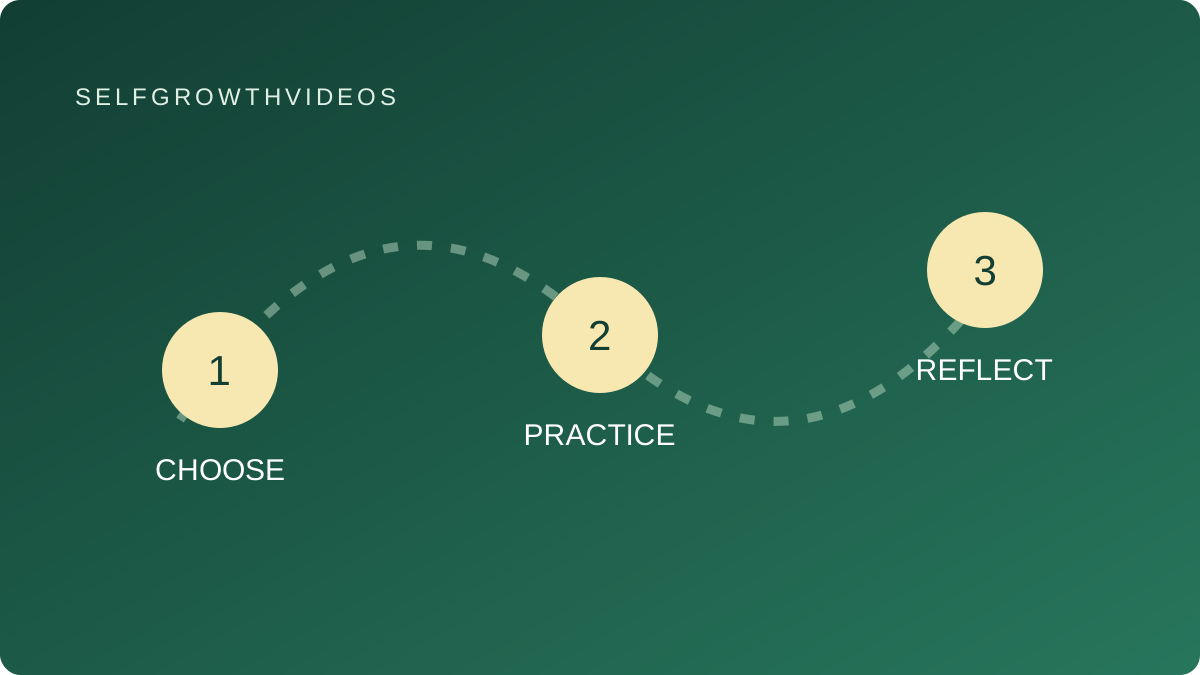 Choose, practice, reflect
A practical learning exercise
The Lesson
You find a prompt that helps turn rough notes into a clear update. A month later, you paste it into a different task. The result includes an old deadline, a previous audience or a confident answer to a question you never supplied. Reusing the wording has also reused its assumptions.
In his public AI Advantage community post, “Five Saved Prompts Beat a Library of Five Hundred”, Igor Pogany argues that a growing prompt collection can create extra searching and uncertainty. He favors a small, named collection with clear ownership. Treat the number in that title as his framing, not a tested rule that every person needs exactly five prompts.
The AI Advantage newsletter’s context exercise, written by Pogany and Daniel Pierce, suggests asking an assistant what information it needs before it begins. That can reveal missing context. You still decide whether the questions are relevant and whether you should share the requested information.
A useful saved prompt is therefore a small working record. Its stable instructions describe the job. Its changing inputs identify what must be supplied again. Its example shows how you checked an earlier result. Keep those parts visibly separate.
Consider a volunteer event update. The stable job might be to produce a short summary for helpers. The changing inputs are the current date, confirmed location and remaining tasks. An old example can demonstrate structure, but its facts should never become the new event’s facts. State that examples illustrate format only.
Give the prompt a plain task name, such as “Helper update from confirmed notes.” Record who maintains it; if you work alone, that person is you. A prompt that worked in one chat may depend on context that will not exist in another. A fresh test makes that dependency easier to notice.
Reflection
- Which repeated writing or organizing task do you actually do?
- Which parts stay stable, and which facts change every time?
- Could another person tell what information the prompt needs?
- What would make an output unsuitable even if it sounded polished?
- Which old examples contain details that should not be reused?
Practice
Original SelfGrowthVideos exercise: create one reusable prompt card. This is our practice, not Pogany’s worksheet or an endorsed method. Use fictional or non-sensitive notes. You can complete the card on paper without an AI account.
- Name the task. Choose one small job and one audience. Write what a useful result should help that reader do.
- List fresh inputs. Use visible placeholders for dates, facts, source notes and length. Add “unknown” as an acceptable input; missing information must remain a question, not become an invented fact.
- Set the boundary. Ask for a draft only. Specify that examples show format, that unsupported details should be flagged, and that nothing should be sent or published.
- Describe your check. For the helper update, every event fact must match the supplied notes, each action must have a known owner or an open question, and the reader should be able to identify the next step.
- Try a new example. Change the date, omit the location and alter one task. If you use an assistant, provide the new inputs in a fresh conversation. Check whether it preserves the missing location as a question. Check the output yourself; asking the model to approve its own answer is insufficient.
- Save the record. Keep the prompt, one fictional test input, your corrected example, the review date and the maintainer together. Mark its current limits. Archive a near-duplicate instead of giving it another vague name.
Review
On the next real use, compare the result with the fresh inputs. Did an old fact return? Did missing context become a claim? How much correction was necessary? Update the card or stop using it if it no longer serves the task. The aim is a prompt you can inspect and maintain; reuse alone does not establish reliability.