Iyanla Vanzant: Clarify Your Part in a Shared Responsibility
How do I distinguish my responsibilities from someone else's choices?
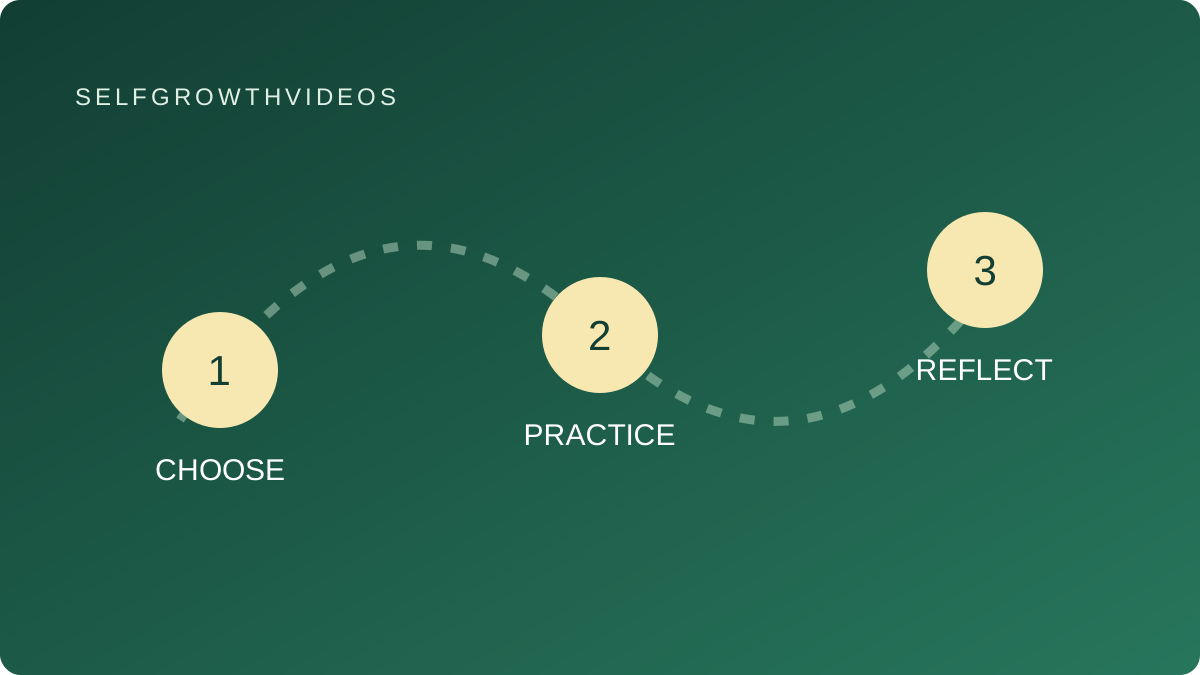 Choose, practice, reflect
A shared responsibility practice
The Lesson
You agree to help a friend prepare for an application. You offer to review their draft on Thursday. By Wednesday evening, you are reminding them to write it, choosing their examples, and worrying about whether they will submit it. A helpful offer has become a job neither of you clearly agreed to.
Iyanla Vanzant’s official teaching on boundaries distinguishes your space, feelings, needs, and responsibilities from another person’s. Her official biography places her work in spiritual teaching and personal development. This lesson takes that distinction into an ordinary shared task; you can use the exercise without adopting her wider spiritual framework.
Start with the agreement. What did you actually promise? What did the other person promise? Which decisions belong to each person? An offer to review a draft does not automatically include writing the application or making its final choices. Naming the difference lets you offer help that has a clear beginning and end.
There is also work that belongs between you. The deadline for sending the draft, the kind of feedback wanted, and the time you can spend may need a conversation. Labeling something “their responsibility” cannot resolve an unclear agreement. If you have already accepted a commitment, explain and negotiate any change rather than silently withdrawing.
Imagine the same distinction in a household. You may agree to book a repair appointment while someone else agrees to be home for it. You can send the appointment details and ask for confirmation. You cannot personally make their calendar choice, but you still need a workable arrangement before booking. Responsibility includes communicating dependencies, not pretending each person works alone.
You can care about someone’s result while keeping your offer realistic. They may decline your suggestion or make a choice you would not make. Your next decision concerns what you can appropriately offer, what you have committed to, and what now needs clarification.
Reflection
- What did I explicitly agree to do?
- What am I doing because I assumed the task would otherwise fail?
- Which decision requires the other person’s answer?
- Which part of our agreement is still unclear?
Choose an ordinary, low-stakes situation where you can discuss the arrangement directly.
Practice
This is an original SelfGrowthVideos exercise, not a worksheet or prescribed method from Iyanla Vanzant.
Draw three spaces on a page: My commitment, Their decision, and Our agreement to clarify. Describe actions rather than character. “Send the draft” is an action; “be less irresponsible” is a judgment that does not specify the work.
For the application example, write:
- My commitment: Read the draft and return comments on Thursday evening.
- Their decision: Choose the examples, write the draft, and decide what to submit.
- Our agreement to clarify: When the draft will arrive and what feedback would be useful.
Now prepare one message: “I can review your draft Thursday evening if you send it by noon. Would you like comments on clarity or on the examples? If that timing does not work, let’s agree on another option.”
Before sending your version, check whether it honors your existing commitments and leaves room for an answer. If the other person cannot meet the condition, discuss a smaller offer or a changed arrangement. Avoid promising to take over simply because a decision remains unresolved.
Review
After the conversation, record what each person agreed to do and when you will check back. Did you clarify a dependency, or only restate your preference? Is there still an unanswered question?
At the check-in, review your part first. Keep it, renegotiate it promptly, or acknowledge where you fell short. Then discuss the shared result without assuming another person’s choice describes their entire character.
Go Deeper
Visit the Iyanla Vanzant teacher profile. For a scheduling conversation, try Nedra Glover Tawwab’s ordinary time boundary lesson. For a wider problem, use Stephen Covey’s concern and influence lesson to identify an available contribution.