Jason Zhou: Check a Research Agent's Evidence Before Using Its Report
How do I turn an AI research report into evidence I can actually check?
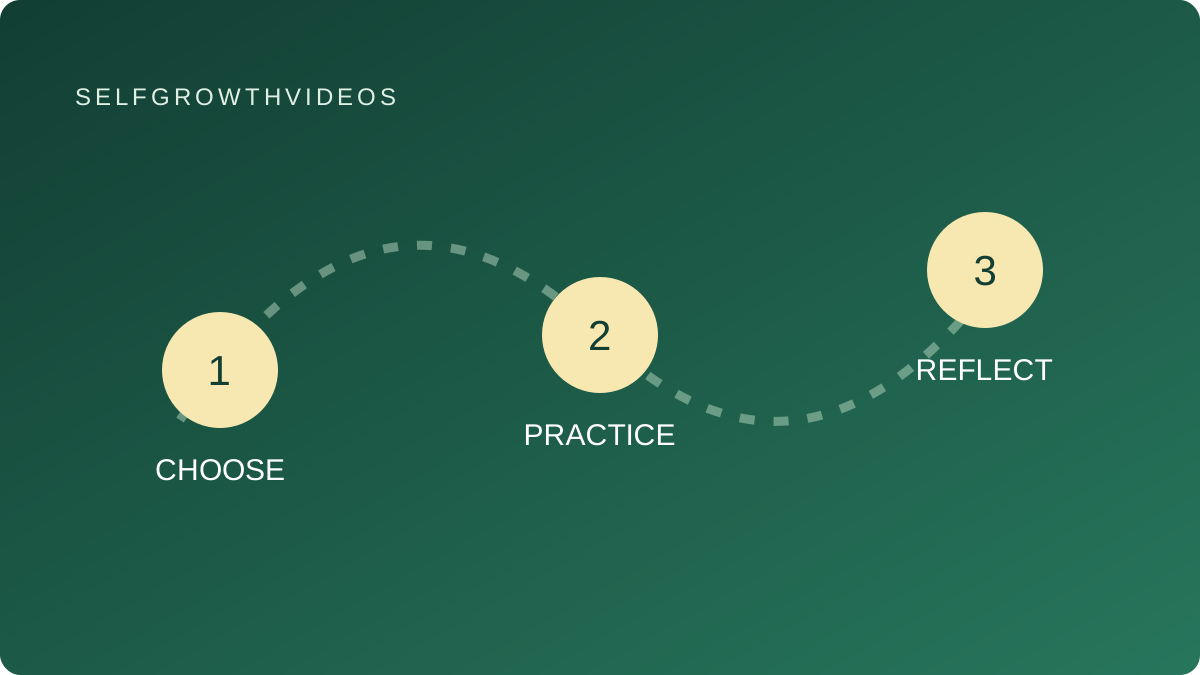 Choose, practice, reflect
A practical learning exercise
The Lesson
You ask an AI research assistant to compare two workshop tools. It returns a confident recommendation and a list of links. Before using that recommendation, you need to know which source supports each important statement and which questions remain unanswered.
Jason Zhou, who publishes as AI Jason, describes research as an iterative process in his written research-agent guide. A later research-system tutorial gives a reviewing role responsibility for checking the researcher’s work. We can apply that separation ourselves: collecting information and accepting a conclusion are different jobs. An agent’s report still needs verification.
A list of links is a starting point. One link may lead to a marketing homepage while the claim concerns a particular plan. Another may describe an older version. A source can be real and relevant to the general topic without supporting the exact sentence beside it.
Ask for a claim-by-claim evidence note. Each row should name the claim, the original source URL, the page or section to inspect, when it was checked and what remains uncertain. This is a SelfGrowthVideos review structure, not Zhou’s named method.
Choose a bounded question. For example: “What can the official documentation confirm about exporting attendance records from two tools?” That is easier to review than “Find the best platform for my business.” The second request mixes features, cost, usability and assumptions about your needs.
Open the important sources yourself. Look for the feature and the conditions around it: a supported export format, a plan restriction or an administrator requirement. If the page does not settle a question, keep the question open. Do not let an assistant replace missing evidence with a likely answer.
Separate three kinds of notes: a sourced fact, an interpretation and a question. “The documentation lists CSV export” may be a fact you can verify. “That would make our handoff easier” is your interpretation. “Does our account have access?” may still need checking.
Set a stopping point. You might stop when both tools have a verified answer to the same narrow question, or when the available official pages leave a specific gap. More searching is useful when it answers a defined question; additional pages do not automatically improve a report.
Current Anthropic web-search documentation describes source citations for search results. Whatever assistant you use, inspect the source behind a citation. A citation does not establish that the conclusion is correct.
Reflection
- Which claim would affect my next decision?
- Does its linked source support the exact claim or only the general topic?
- Have I recorded a limitation that could change the interpretation?
- What unanswered question should stop me from acting on the report?
Practice
Original SelfGrowthVideos exercise: review a small evidence table. This is our worksheet, not Zhou’s agent implementation or an endorsement.
- Choose a harmless practice question about two tools you already know, such as whether their official documentation describes exporting a list. You can instead use two public learning resources and compare their stated prerequisites.
- Name the exact feature or prerequisite you want checked. Ask the assistant to use official sources, return supporting URLs and mark unanswered questions explicitly.
- Request a table with: claim, source URL, section to inspect, date checked and limitation. Ask it to distinguish findings from its recommendation.
- Open the source for each important row. Record whether it directly supports the claim, contradicts it or does not resolve it.
- Correct unsupported wording. Add a question instead of inventing an answer when a plan condition or account detail is missing.
- Save the original report and the reviewed version. Finish with one supported finding and one remaining uncertainty.
If your assistant cannot browse, provide public source text you have checked, or complete the table by hand. Do not claim that it checked a page it could not access.
Review
At your next check-in, choose one finding and revisit the original page. Is it still applicable to your situation? Has the documentation changed?
Use the reviewed note to decide the next question. Keep any recommendation separate from verified facts, and leave unresolved details visible until you have evidence.
Go Deeper
Explore Jason Zhou’s profile and selected publisher videos and AI Agents & Automation. Continue with writing a reviewable agent handoff or apply the evidence table to a sample in research services.