Louise Hay: Write a Realistic Supportive Reminder
How do I write a supportive reminder that I can honestly use?
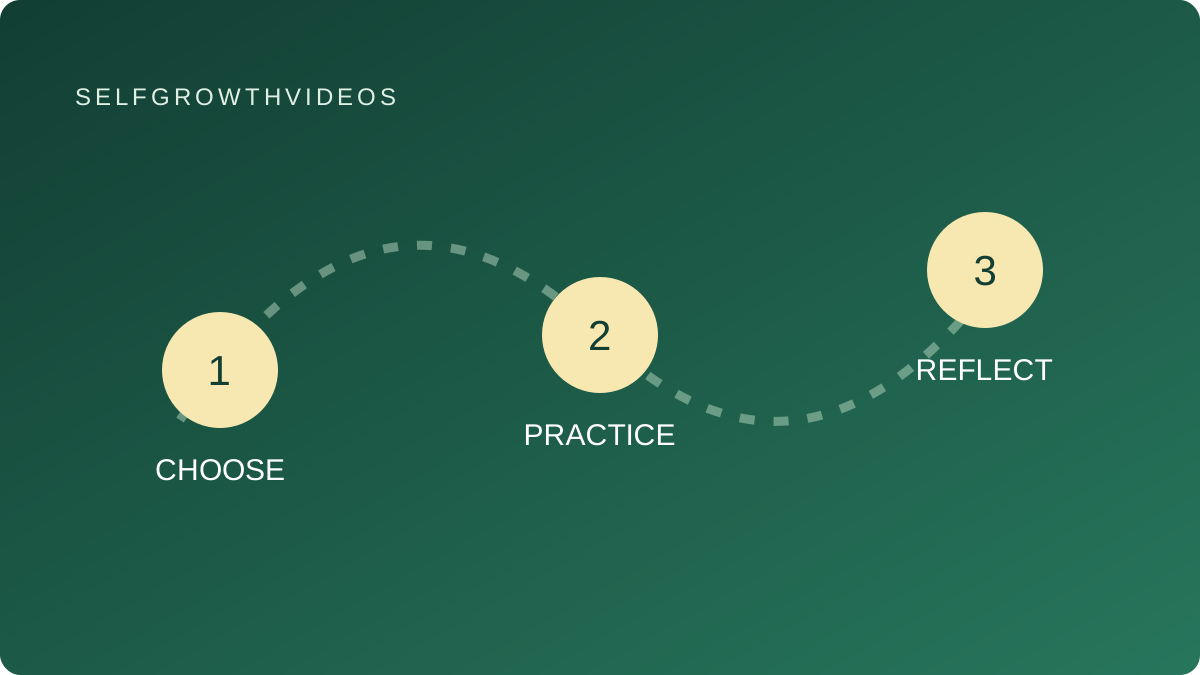 Choose, practice, reflect
A practical learning exercise
The Lesson
A supportive sentence can be difficult to use when it asks you to pretend. If you are learning an unfamiliar task, saying that you are already excellent at it may not fit your experience. You can write something kinder and more useful while acknowledging that you still have work to do.
Louise Hay, the author of You Can Heal Your Life, made affirmations central to her teaching. In What Is Mirror Work?, she treats self-talk as a stream of affirmations and encourages supportive messages during ordinary and difficult moments. Her account includes a spiritual healing framework. Here, use the narrower invitation to examine the words you direct toward yourself; this writing practice makes no claim that affirmations cure illness or determine external events.
For this lesson, a supportive reminder has two jobs: acknowledge the situation and point toward a response you can choose. It does not have to predict that everything will go well. You can write, “I am new to this task, and I can ask which step needs correcting.” The sentence leaves room for inexperience and for useful action.
Compare that with “I never make mistakes.” The latter gives you no way to respond when a mistake occurs. Or consider “Everyone will approve of my work.” Other people’s reactions are outside your control. A reminder can instead concern preparing carefully, asking a clear question, or deciding what feedback to use.
The wording should also allow real limits. If you lack a necessary resource, being supportive can mean acknowledging that gap and deciding whether to request help or postpone. You do not need to turn every difficulty into a demand for greater effort.
Reflection
- In which ordinary situation do I want a more supportive sentence?
- What is true about that situation, including what I am still learning?
- What response is actually available to me?
- Does my proposed sentence ask me to guarantee something I cannot control?
Choose a manageable situation, such as revising a paragraph, asking a question in a class, or returning to an unfinished household task.
Practice
This is an original SelfGrowthVideos exercise, not Hay’s mirror-work program or an endorsed affirmation formula.
Describe the situation in one factual sentence. For example: “My practice presentation ran past the time available.” Keep the description specific enough to suggest a response.
Draft a reminder with two parts: an acknowledgment and an available choice. A possible version is: “This version is too long, and I can remove one example before rehearsing again.”
Read it using four checks:
- Truth: Can I say this without denying what happened?
- Kindness: Would I consider it a respectful way to address someone else learning the same task?
- Choice: Does it point toward something I can do, request, or deliberately defer?
- Limits: Does it leave room for uncertainty, other people’s choices, and constraints?
Revise any part that fails a check. “I must impress everyone next time” might become “I can make the main point clearer and ask what the listener understood.” “I should have mastered this already” might become “This part is unfamiliar; I can identify the instruction I need.”
Write your revised sentence where it will be relevant, such as beside the draft you are editing. Choose one real occasion to read it. Then decide whether to take the action it names. You do not have to feel convinced, confident, or cheerful before you can examine the next step.
Afterward, make a short note: what you said, what you did, and whether the wording was usable. If the sentence felt demanding or false, revise it. If the action was unavailable, name the missing condition instead of treating that limit as a personal failure.
Review
At your next check-in, read the sentence again alongside the actual situation. Does it still fit? Did it help you identify a response, or did it add pressure?
Keep, change, or set aside the reminder based on that review. The aim is a respectful sentence you can use in a specific moment, with no promised transformation or required timetable.
Go Deeper
Explore Louise Hay’s teacher profile and her official biography. To distinguish an event from your immediate commentary, try Michael Singer: Notice Inner Commentary. To turn a workable response into a small practice, use One Goal, One Week.