Mark Manson: Try the Routine Work Before Choosing a Business Idea
Compare two ordinary work samples before choosing which business idea to explore.
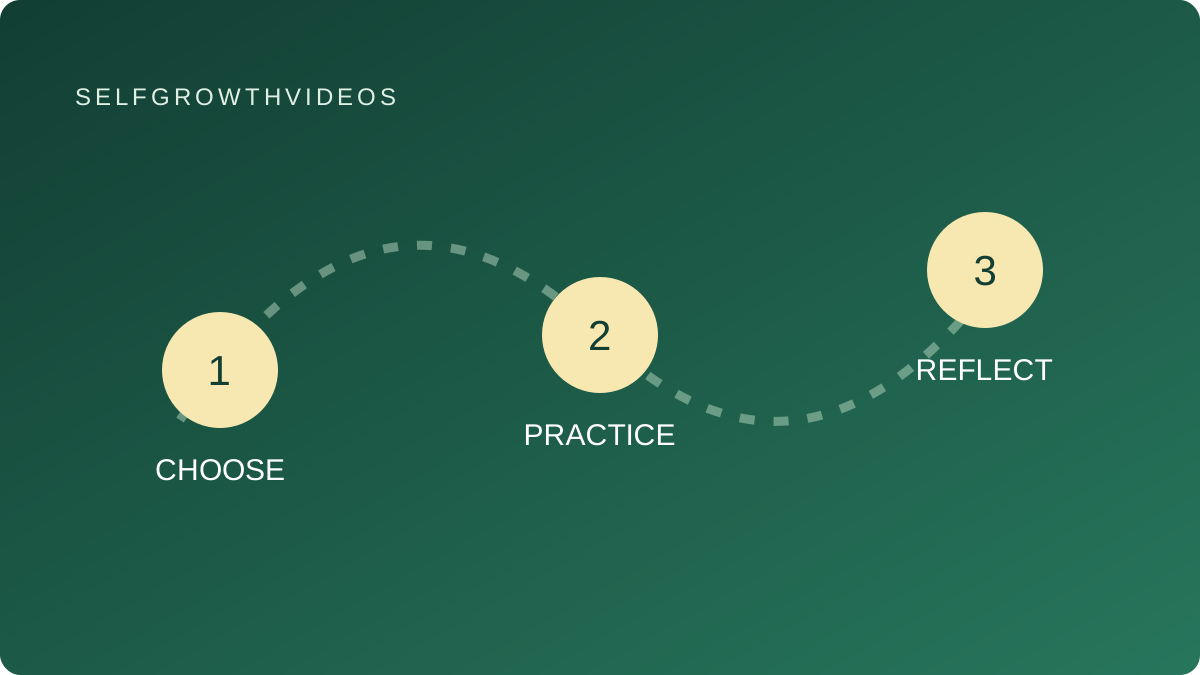 Choose, practice, reflect
A practical lesson
The Lesson
Which small-business idea deserves a place in the limited time you actually have? A promising label can hide very different daily work. Editing a newsletter might involve checking names, fixing unclear sentences and asking about missing information. Organizing an event information sheet might involve comparing details, resolving contradictions and keeping a document up to date. Decide what you want to try by looking at those tasks.
In The Most Important Question of Your Life, Mark Manson distinguishes wanting an attractive result from wanting to take part in the process that produces it. He illustrates that distinction with his former ambition to become a musician: the imagined performance appealed to him more than the routine work surrounding it. The essay is his perspective on choosing worthwhile effort, rather than a test that predicts business success. His official biography identifies him as the author of The Subtle Art of Not Giving a F*ck and other books.
Our practical application is to compare two ordinary work tasks before choosing a first business idea. Include the repetitive or fiddly part you would otherwise leave out of the description. Then try a small version inside a real opening in your week. You are gathering information about the work and your present circumstances.
Difficulty alone does not make an idea valuable. A task that interferes with essential responsibilities, requires skills you do not yet have or leaves you wanting to stop deserves an honest response. You can change the task, learn a prerequisite or choose another direction. This exercise asks what effort seems worthwhile to you; it does not ask you to prove commitment through exhaustion.
Reflection
Choose two ideas that interest you. For each, complete these sentences privately:
- The result I like imagining is…
- An ordinary task I would probably need to repeat is…
- The part I would be tempted to skip is…
- One opening I could actually use to explore this is…
Be specific about the last answer. An available half hour on Saturday is more useful for this exercise than an imaginary future with unlimited evenings. Treat caring duties, rest, your job and other existing commitments as part of the situation.
Which idea can you describe through an observable task? If all you can name is an identity such as being a creator or an entrepreneur, make the task smaller before continuing.
Practice
Original SelfGrowthVideos exercise: compare two routine-work samples. This is our learning activity, not a Mark Manson method or an endorsed business assessment. Use fictional material or information you are allowed to use. Keep the samples private.
- Choose one available window. Set a finish time that respects the commitments around it. For example, a thirty-minute window could hold five minutes of preparation, ten minutes for each sample and five minutes of notes. Those times are an optional practice format, not a professional work estimate.
- Write two task cards. Give each card an idea, a routine task, an input and a visible stopping point. For newsletter editing, the input could be a fictional paragraph with inconsistent dates; the stopping point could be a corrected paragraph with unresolved questions marked. For an event information sheet, use two fictional notices and finish a short list of details that disagree.
- Include the less appealing part. Check the dates rather than only improving the headline. Compare the notices rather than only decorating the sheet. Include enough ordinary detail to learn something about doing the work.
- Try both samples within the window. Stop at the planned time even if a sample remains incomplete. Record what you reached and where you got stuck. An unfinished sample is still useful information; do not silently give one idea extra time to make it win.
- Make a comparison note. For each task, write what held your attention, what you avoided, what skill or information was missing and whether you would willingly explore another small sample. Choose a provisional next learning task, or leave both ideas open if you need better inputs.
The output is two task cards, two small attempts and a comparison note. You do not need a public launch, a new account, equipment purchases or a client commitment to complete this learning exercise.
Review
Read the comparison before planning your next available window. Did you prefer doing one task, or mainly prefer imagining its finished result? Did a missing skill make the trial uninformative? Did the work fit the opening you selected without spilling into another commitment?
A short private sample cannot establish customer demand, full delivery time, suitability for a regulated activity or financial viability. Keep those questions open. If one idea merits further exploration, identify the next question you need to answer rather than treating enjoyment as proof that a business will work.
Keep your notes with the Business Launchpad idea module. When you are ready to investigate someone else’s actual needs, use Marie Forleo: Listen Before Designing an Offer.
Go Deeper
Visit Mark Manson’s teacher page for his existing video library. Continue through Starting & Managing the Work for related business foundations. Once you have a clearer task to explore, Jenny Shih: Choose One Result for a First Service Trial can help you define a bounded learning result.