Mark Victor Hansen: Record a True Story of Service
How do I record a small story of someone helping another person?
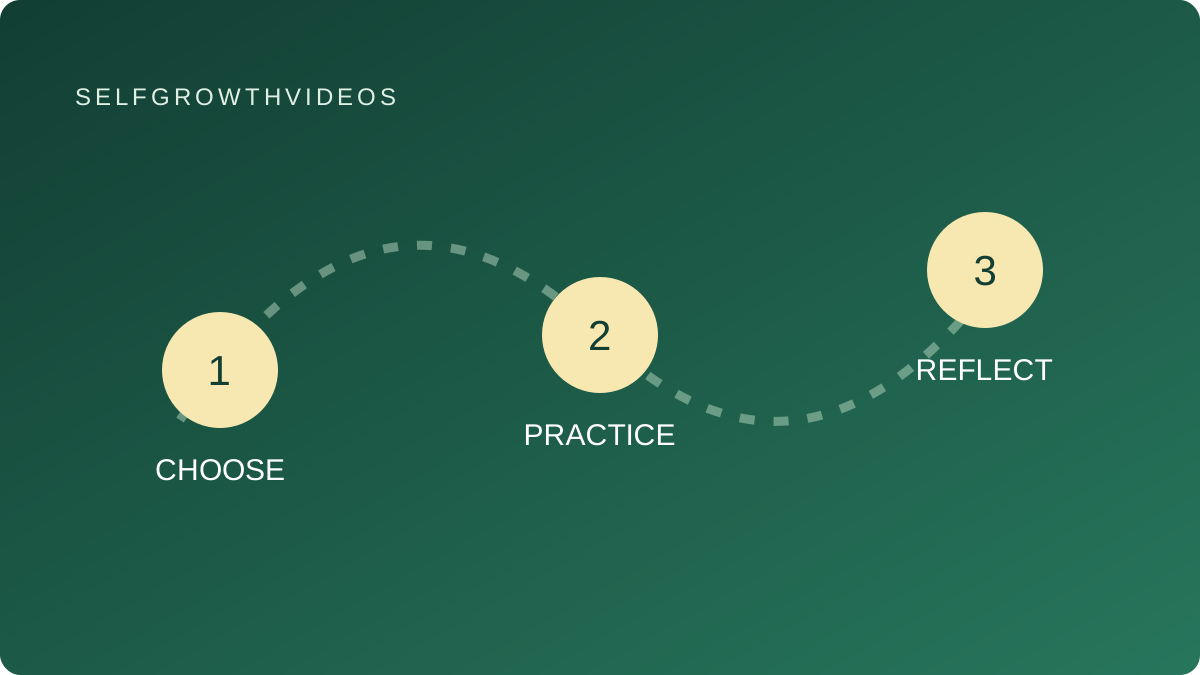 Choose, practice, reflect
A practical learning exercise
The Lesson
An ordinary act of help can be easy to overlook: somebody explains an unfamiliar form, makes room for another person’s contribution, or completes a task that keeps a shared project moving. Recording what happened can give you a concrete example of service to learn from. The challenge is to preserve the person’s actual contribution without inventing a more dramatic story.
Mark Victor Hansen and Jack Canfield co-created Chicken Soup for the Soul. The publisher’s history describes how they collected personal stories and brought them together in the original book. Its current story guidelines emphasize true experiences and concrete storytelling, including accounts of helping others. Those current guidelines belong to the publisher; they are not a personal worksheet by Hansen.
Use that connection as an invitation to pay attention to real help. Begin with the need, the action, and what you could observe afterward. If a neighbor carried groceries upstairs, you can describe the carrying. You cannot know that the recipient felt restored hope unless they actually told you that. Even then, their words describe their experience; they do not explain everything about their life.
A useful account also recognizes the recipient’s agency. Someone may have asked for a particular kind of help, declined another offer, or contributed their own work. Include those choices when you know them. Service is easier to understand when the people receiving it remain participants in the story.
You may discover that the most useful contribution was quiet preparation: checking what was needed, organizing materials, or following through after an event. Record what made the action helpful rather than trying to make its scale impressive.
Reflection
- Which act of help have I actually witnessed or experienced?
- What need did it address, and how do I know that?
- What did the person do that another person could learn from?
- Which details belong to someone else’s private life?
Choose an ordinary event you can describe accurately. A private note is a complete outcome for this exercise; publication is optional.
Practice
This is an original SelfGrowthVideos exercise, not a Chicken Soup for the Soul submission assignment or a method endorsed by Hansen.
Make four short notes about one real event:
- The situation: What was happening immediately before the help?
- The contribution: What did someone actually do?
- The response: What did you observe, or what did a participant tell you?
- The limits: What remains unknown, and what did the action leave unresolved?
For a hypothetical example, imagine a volunteer explaining how a shared tool is returned. The contribution is the explanation. The observable response might be that a new participant returned it to the correct shelf. Whether the participant felt welcomed remains unknown unless they said so. A clear record does not need to add that feeling to make the action worthwhile.
Now write a short account of your real event. Keep the sequence easy to follow. Describe a specific action instead of assigning a broad label such as “wonderful person.” Use quotation marks only for words you can reliably reproduce; otherwise paraphrase and identify the speaker.
Read it again and mark three kinds of statement: what you witnessed, what someone reported, and what you inferred. Revise any inference that reads as a fact. If an important detail is uncertain, acknowledge the uncertainty or leave it out.
Finish with one sentence about what the account teaches you about helping: perhaps asking what is needed, giving an understandable explanation, or completing an agreed task. Keep the lesson proportional to the event. A helpful moment does not prove that every problem was solved.
Keep the account private unless you decide there is a good reason to share it. Before sharing an identifiable account, ask the people involved about the details and their permission. If permission is unavailable, keep the note private rather than assuming that changing a name removes every identifying detail.
Review
Revisit your account after a few days. Is the action still clear without added drama? Have you credited the people who contributed, including the recipient’s own choices? What detail needs checking?
Choose one aspect of the service you could learn from in your own circumstances. Consider whether it would be welcome there; repeating an action is useful only if it addresses a real need.
Go Deeper
Explore Mark Victor Hansen’s teacher profile. For another way to describe lived experience, try Maya Angelou: Write One Ordinary Scene. To recognize a contribution directly, use Tabitha Brown: Offer Specific Encouragement.