Matt Wolfe: Turn dots and Muse News Into One Useful Test
Which small task would show whether a new AI assistant is useful to me?
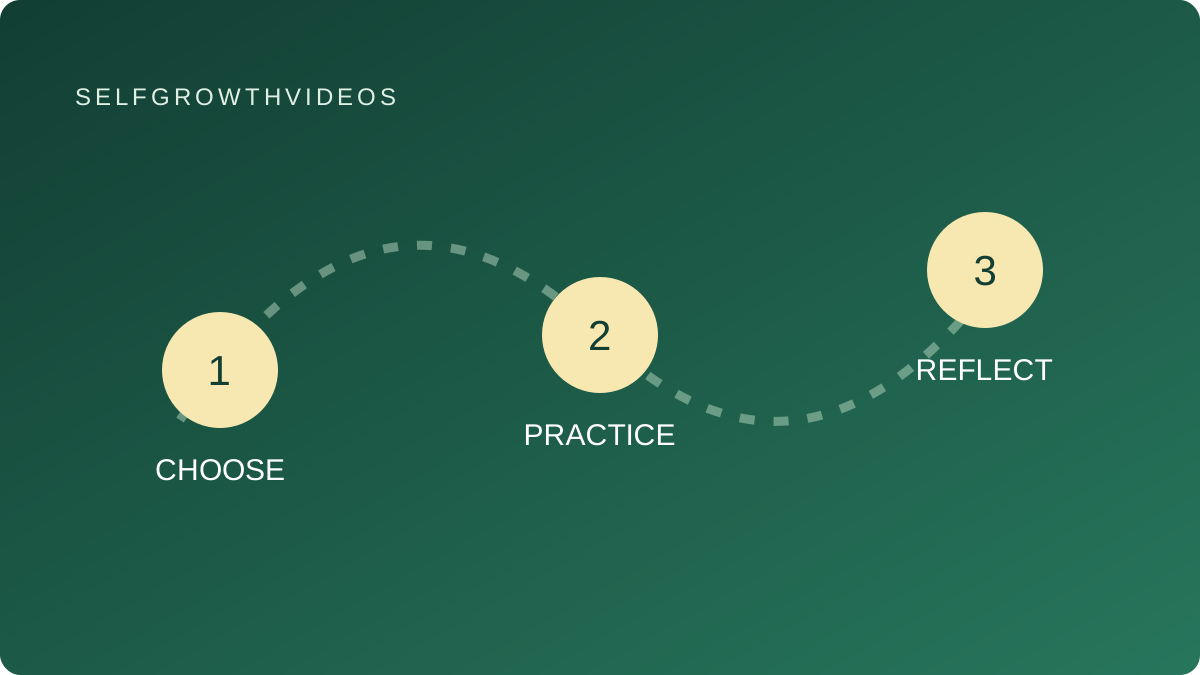 Choose, practice, reflect
A practical learning exercise
The Lesson
You see another announcement about an assistant that can keep working while you are away. You save the link, watch a demonstration, and start wondering whether you should change your whole setup. A smaller question is more useful: what task would help you decide whether this matters for your life?
Matt Wolfe’s official site organizes AI tools and news and links to coverage of OpenAI dots and Meta Muse. In his dated 2023 note about following AI, he describes research as a substantial part of his work. Following that coverage can help you discover a tool. Choosing a test for your own needs remains a separate decision.
The providers describe dots and Muse as agents that can act on tasks across connected tools. OpenAI’s dots introduction explains app permissions, action review, and inspecting an agent’s work. Meta’s Muse introduction describes choosing connected services and their access, along with reviewing sensitive actions. These are official product descriptions, not independent proof that either assistant will complete your particular task well.
Pick a job you already understand. For example, turn an invented set of project notes into a preparation checklist. You know what information is available and what the checklist should preserve. That makes a result easier to judge than an open-ended request to improve your productivity.
Write the criteria before trying the tool. Your checklist might need to distinguish completed work from remaining work, retain the date of a decision, and flag an uncertain detail. If you decide what counts after seeing the output, polish can distract you from omissions.
Compare the entire experience. Can you locate the source of a statement? How much correction does the draft need? Can you find the relevant settings and understand what actions the assistant may take? A pleasing answer is only one part of a usable workflow.
Keep the first experiment modest. Use invented notes, ask for a draft, and leave sending or editing external content outside the task. You are learning how to judge a result, not proving a system ready for every project. Check current access and settings in the provider’s own resources before a real trial.
If you cannot access either product, complete the preparation on paper or with an assistant you already use. The comparison questions remain useful. The point is to turn awareness into a decision you can explain.
Reflection
- What repeated job do I want help with?
- Can I describe an acceptable result without naming an AI product?
- Which omission would make a polished answer unusable?
- Am I choosing the next test because of a real need or because of a striking demonstration?
Practice
This is an original SelfGrowthVideos exercise. It is not Matt Wolfe’s testing method and does not imply endorsement by Wolfe, OpenAI, or Meta.
Write six invented project notes. Include one completed task, one unresolved question, one deadline, and one detail that should not become a confirmed fact.
Before asking an assistant to work, write three checks. For example:
- Completed and remaining work appear separately.
- The deadline appears exactly as provided.
- The unresolved question remains a question.
Ask for a short preparation checklist using only those notes. Keep the task limited to producing a draft. If you test two assistants, give both the same notes and request.
Check each result against your criteria. Record a correct detail, an omission or ambiguity, and a correction you had to make. Do not declare a winner from one sample. Write the next question your experiment raises instead.
Review
Return to your comparison before changing your regular workflow. Did either result help with the task you named? What work did you still need to do? Would another example reveal a different weakness?
Choose whether to revise the instructions, test another example, use the assistant only for this limited draft, or keep your existing process. Save the notes and criteria so future product updates can be compared with the same task.
Go Deeper
Explore Matt Wolfe’s creator profile, the AI study area, and prompt engineering. For identifying whose experience matters when judging a tool, read Fei-Fei Li: Compare Two People’s Experience of an AI Tool.