Michelle Obama: Explore a Direction Without Deciding Your Whole Future
How do I describe a direction I want to explore without promising a fixed future?
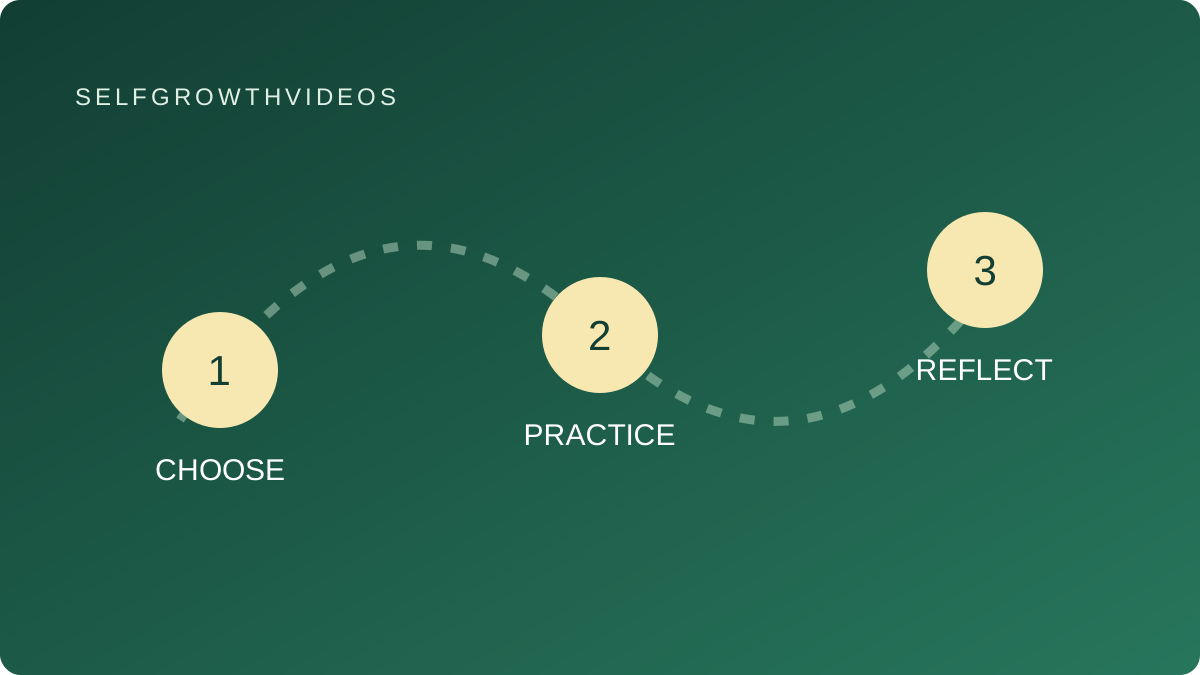 Choose, practice, reflect
A practical direction lesson
The Lesson
Someone asks what you plan to do with your life. You have an interest in working with people, making things or learning a new skill, but no confident job title to offer. The question starts to feel like a demand for a finished identity.
Try giving a more useful answer: name a direction you want to investigate and the next experience that could teach you something about it. A direction can guide an action while leaving room for what you have not learned yet.
What Michelle Obama’s writing invites you to consider
Michelle Obama’s memoir Becoming follows experiences that shaped her life across family, work and public service. Her official book page identifies both the memoir and its companion guided journal. In an introduction excerpt shared by her publisher, she encourages readers to record their experiences and feelings without requiring them to be perfect. The publisher describes the journal as a place to reflect on history, hopes and possible futures. Publisher’s announcement and introduction excerpt.
The publisher’s reading guide for Becoming also asks readers to consider her adjustment of earlier plans and her transition from corporate law toward public service. These are invitations to examine how a path develops, rather than evidence that everyone should follow her career choices.
The direction exercise below is an original SelfGrowthVideos practice. It is not Michelle Obama’s worksheet or a method she prescribes, and it does not imply her endorsement of this site.
Separate the attraction from the title
Suppose you keep saying you should become a designer. What interests you about that possibility? You might enjoy arranging information, listening to people’s problems, drawing or working independently. Those interests point toward different experiences. A job title hides that difference; describing the activity makes it easier to explore.
Also notice whose approval is inside the ambition. Wanting to make a family member proud can matter to you. It still helps to distinguish that wish from enjoying the work itself. You do not have to reject other people’s hopes to ask what attracts you and what you actually know about the daily activity.
Make the next step answer a question
An exploration works better when you can say what you hope to learn. Instead of deciding that you are suited to teaching because you like helping people, ask whether you enjoy preparing an explanation and adapting it when someone is confused. You could help a willing friend understand a familiar topic, then ask what was clear and what needed another example.
That experience will not establish your qualifications or settle a career decision. It can give you a concrete observation to bring to your next conversation or learning opportunity. Choose an activity that fits your current responsibilities and resources. A small exploration can coexist with paid work, school or caregiving.
Reflection
- Which activity am I curious about, underneath the title or status attached to it?
- What have I actually tried, and what am I imagining from a distance?
- Whose expectations influence my answer? Which parts also matter to me?
- What would I need to observe before making a larger commitment?
Practice
Use a sheet of paper or an ordinary notes app. This is an original SelfGrowthVideos exercise; you do not need a purchased journal.
- Describe the interest. Finish this sentence: “I want to explore work or learning that involves ___ because ___.” Name an activity and a reason, rather than only a title.
- Choose a question. Write one thing you do not yet know about doing that activity. Keep it answerable through a modest experience.
- Plan the experience. Pick an appropriate first attempt, such as making a simple example, attending an introductory session or asking someone about a specific part of their work. Set a practical limit on time and spending, and seek permission where another person is involved.
- Record what happened. Describe one moment that interested you, one difficulty and one new question. Keep observations separate from judgments about your worth.
For example: “I want to explore explaining technical ideas because I enjoy making confusing instructions usable. My question is whether I enjoy revising an explanation after feedback. I will write a short guide for a task I know and ask a willing reader where they get stuck.”
Your working direction statement might become: “I am exploring technical communication. Next I want to learn whether I enjoy testing and revising instructions.” That is a clear answer you can revise as your experience grows.
Review
After the experience, ask whether you learned something about the activity itself or only about its setting. Disliking one poorly organized session does not settle your interest in the whole field. Enjoying one attempt does not require an immediate career change.
Choose a next response: repeat the activity under different conditions, learn a missing skill, ask a more focused question or explore another direction. Write why you chose it. Changing your statement in response to experience is part of the exercise, not a failure to keep a promise.
Go Deeper
Explore Michelle Obama’s teacher profile for the existing video library and book resources, or browse the Purpose learning hub.
Once you have an activity to explore, Simon Sinek: Give a Small Project a Clear Purpose can help you describe whom a project serves. If starting the attempt is the obstacle, try James Clear: Make the First Step Easier.
Books on this topic
Books from this library that go deeper on the ideas in this page.

Some links on this page are affiliate links. As an Amazon Associate I earn from qualifying purchases. How affiliate links work here