Oprah Winfrey: Keep Book Notes You Can Return To
How do I keep useful notes from a book instead of collecting quotations I never revisit?
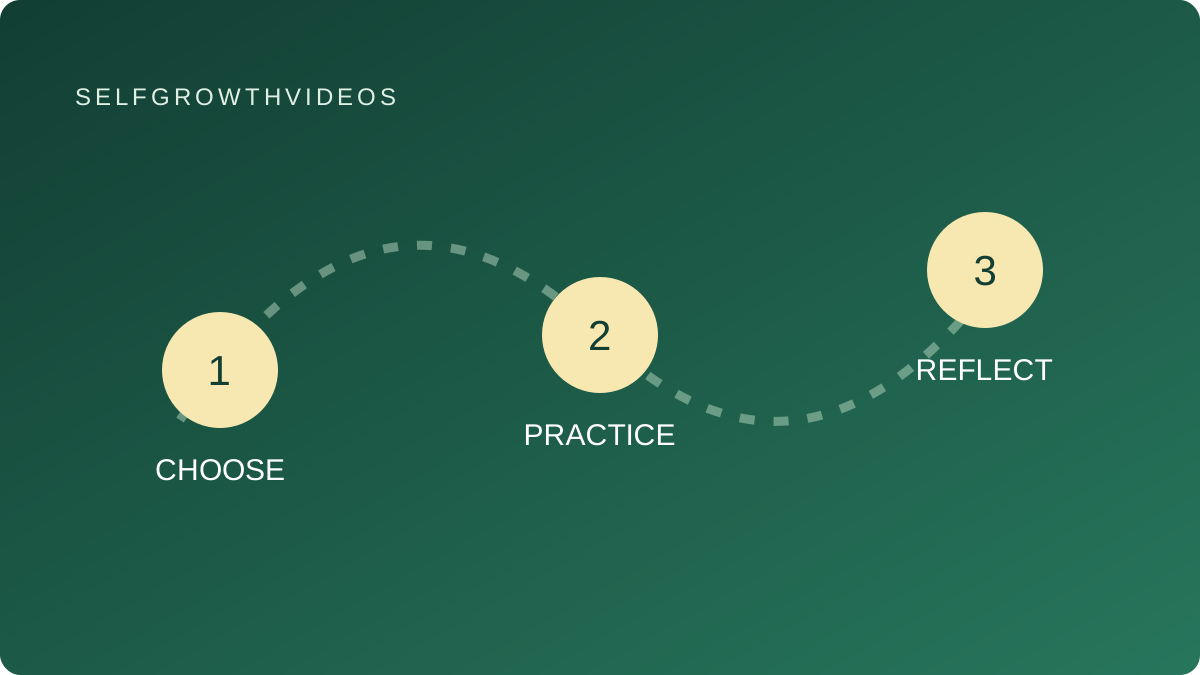 Read, notice, revisit
A practical reading lesson
The Lesson
You finish a chapter, underline a sentence and save a photograph of the page. A week later, the photograph still looks important, but you cannot remember what you wanted to do with it. The sentence survived; your response to it did not.
A useful reading note gives your future self a way back into the conversation. It records enough context to locate the passage, an explanation in your own words, and a question that matters to you. You can make one on paper or in an ordinary notes app. You do not need to buy a journal, join a club or finish an entire book first.
What Oprah’s reading example offers
In her essay “Oprah Shares the Books That Changed Her Life”, Oprah Winfrey describes reading as a way to find language for her experience and encounter other perspectives. She recalls recognizing herself in Maya Angelou’s memoir, exchanging books with Alice McGee, and seeking themes she could discuss with others. Her account emphasizes a relationship with a book: what you notice, why it matters and what you want to talk about.
Her own writing also offers a reflection companion. The publisher’s page for What I Know For Sure describes a collection drawn from her magazine columns, organized around taking stock of life. That is a reason to pause over a reading response, rather than treat every appealing sentence as a rule you must adopt.
The note format below is an original SelfGrowthVideos exercise. It is not an Oprah worksheet, a method she prescribes, or an endorsement of this site.
Keep the text and your response distinct
Begin with where you found the idea: book title, author and chapter or page. Page numbers vary between editions, so a chapter heading or ebook location can be more useful than a number alone. For an audiobook, record the chapter and an approximate timestamp.
Then describe what is happening in the passage. In a novel, who is speaking? What has happened immediately before this moment? In nonfiction, what problem is the author discussing, and what conditions limit the advice? A character’s statement is not automatically the novelist’s instruction. A sentence about one person’s life is not a promise about yours.
Next, write your response separately. “This reminds me of my first week at a new job” is your association. “The author recommends asking for instructions before beginning” is a claim about the text that you should check against the passage. Keeping those sentences separate lets you disagree, revise an interpretation or notice a connection without putting your words into the author’s mouth.
Give the note a question
Imagine you read a scene in which a newcomer hides their uncertainty instead of asking a question. This is a fictional example for the exercise, not a scene attributed to one of Oprah’s selected books.
An initial note might say, “Be confident.” That leaves you little to revisit. A more useful note could say: “The character wants to appear capable, so they pretend to understand the instructions. I recognize that temptation when I start an unfamiliar task. What question would help me begin honestly?”
The question can lead to a small action: at your next volunteer session, ask the coordinator to show you the first step. It can also lead to more reading: “Does the character behave differently later?” Either response is worthwhile. A novel can invite curiosity, pleasure or a changed perspective without becoming a productivity assignment.
If a passage unsettles you, record the uncertainty. You can write, “I do not agree yet,” or “I need more context.” Your notebook can hold an open question; you do not have to force a lesson out of every page.
Reflection
- Which recent passage can I find again, and what drew my attention to it?
- What does the text actually say, and what am I bringing from my own experience?
- Do I want to understand the idea, discuss it, question it or try something related to it?
- What would make this note useful when I return to it?
Practice
An original SelfGrowthVideos exercise: make one reading note.
Choose a short passage from something you already have access to, including a library book, an essay or an audiobook. Use this format:
- Find it again: Write the title, author and location. If you copy a short phrase into your private note, mark it as a quotation; keep your paraphrase separate.
- Describe it: Explain the idea or scene in one or two sentences of your own. Recheck the passage if your summary seems stronger than the original.
- Name your response: Write why it caught your attention. A memory, disagreement, emotion or practical concern is enough.
- Leave one question: Choose something you can investigate through another passage, a conversation or a small ordinary action.
- Choose a return point: Decide when to reopen this particular note, such as after the next chapter or before a relevant conversation.
For the fictional newcomer example, the question might be, “What do I need clarified before I begin?” The action could be to ask one specific question at the next session. Keep the attempt small enough that you can describe what happened afterward.
If you prefer discussing books, share your interpretation and ask the other reader what they noticed. Let them give a different answer. Reading together is an opportunity to compare perspectives, not to prove that your highlighted sentence has only one meaning.
Review
At your chosen return point, read the note before adding another one. Can you still locate the passage? Does your explanation match it? Did the question lead somewhere useful, or does it need to change?
If you tried an action, record the actual result. “I asked for a demonstration and learned where to begin” is a useful observation. If nothing happened, note what prevented the attempt. Neither result proves that a whole philosophy is right or wrong.
Keep, revise or set aside the note. The aim is a record of your encounter with the book that you can understand later. One honest, revisitable note can serve that purpose without a folder full of extracted quotations.
Go Deeper
- Visit the Oprah Winfrey teacher profile for her existing books and conversation library.
- Explore Maya Angelou’s teacher profile for a writer Oprah discusses in her reading essay.
- Browse the Storytelling learning hub to consider how a scene, voice or perspective shapes what you notice.
- Use Build Better Habits if you want to make returning to a reading note easier within your current routine.
Books on this topic
Books from this library that go deeper on the ideas in this page.

Some links on this page are affiliate links. As an Amazon Associate I earn from qualifying purchases. How affiliate links work here