Rich Roll: Examine a Workweek Before Changing Direction
What exactly do I want to change about my working week?
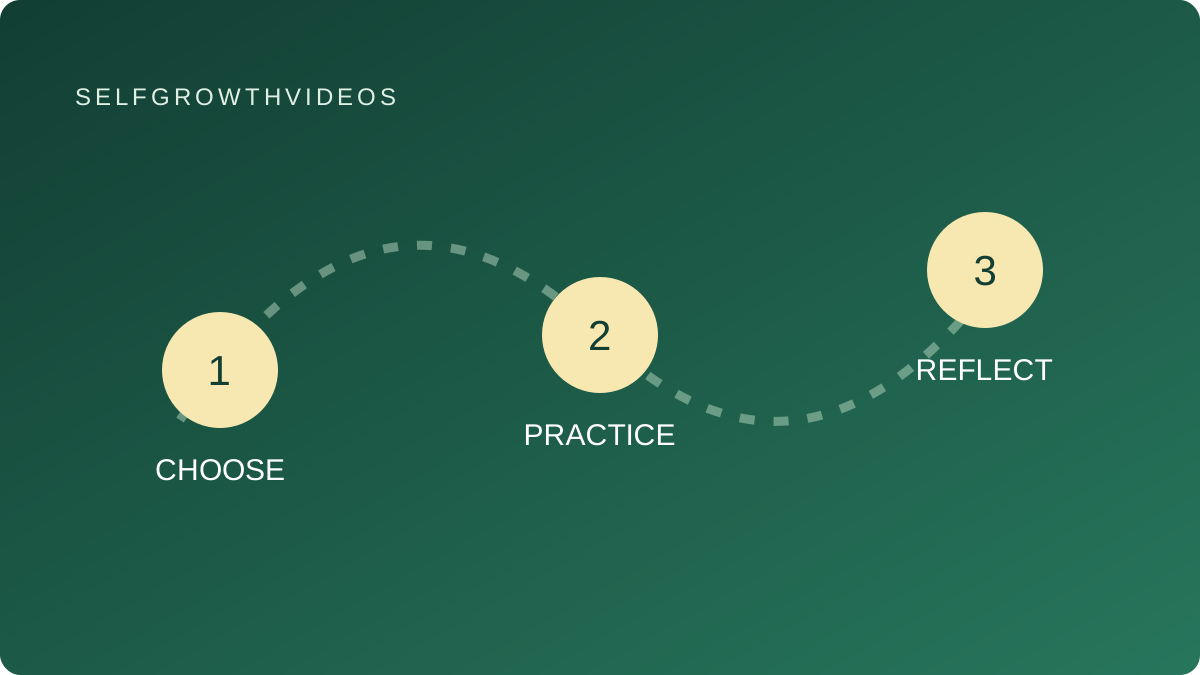 Choose, practice, reflect
A practical direction exercise
The Lesson
By Friday you are saying, “I need a different life.” You may be noticing something important. Before deciding what the entire next chapter should be, describe the parts of the current week that prompted the statement. A specific observation gives you something to investigate.
The written introduction to Rich Roll’s solo episode on change presents willingness to change and receiving help as themes in his personal account. It also challenges the idea that someone must wait for a crisis before considering change. His official biography page identifies his work as a podcast host and the author of Finding Ultra and other books.
Use that invitation to examine an ordinary working week. You do not need to reproduce Roll’s life story to ask what should change in your own. His account is a personal perspective, not a guarantee that willingness alone removes difficult circumstances.
The exercise here separates the activity from the conditions around it. Perhaps you enjoy explaining a process but dislike being asked to explain it without preparation. Perhaps you enjoy making something but have too many competing assignments. Perhaps the central task itself no longer interests you. Those observations raise different questions.
Start with moments you can describe. “Tuesday’s planning call ended without deciding who would finish the draft” gives you more to examine than “every meeting is pointless.” Describe what happened, what you were trying to do, and what prevented or supported it. Your response matters, but it does not have to become a claim about every workplace or your whole future.
Then consider the pattern cautiously. One difficult afternoon may reflect an unusual deadline. Several similar moments may justify a closer look. A week is a sample of experience; you can use it without treating it as a complete assessment of a job, course, or vocation.
This approach also applies to unpaid work, study, or caring responsibilities. Use the words that fit your life. The aim is to identify a concrete question before making a larger commitment, while recognizing that some conditions require other people’s cooperation or resources you do not currently have.
Reflection
- Which actual moment led me to say that something needs to change?
- Was the difficulty in the task, its timing, its instructions, or something else?
- Which part of the week would I want to keep?
- What am I assuming would be different somewhere else?
You may discover both a valued activity and an arrangement that needs attention. Record both rather than forcing the week into an entirely good or entirely bad story.
Practice
This is an original SelfGrowthVideos exercise. It is not a worksheet or method prescribed by Roll and does not imply his endorsement.
Choose three moments from a recent ordinary workweek: one you would like more of, one you would like to change, and one that leaves you uncertain. For each, write:
- Activity: What was I doing?
- Conditions: What timing, information, resources, or people were involved?
- Observation: What happened that I can describe without guessing someone else’s motives?
- Question: What would I need to learn before drawing a larger conclusion?
For example: “I enjoyed answering a colleague’s question about a tool. I struggled when several requests arrived while I was finishing another assignment. I want to find out whether an agreed time for routine questions would help us both.”
Choose one question from your notes. Decide whether it calls for another observation, a conversation, or a modest adjustment you are authorized to make. If an adjustment affects somebody else, discuss it before treating it as agreed. Record the existing responsibilities it must respect.
Keep the question narrow: “Do I dislike explaining the work, or the interruptions?” is something you can investigate. “Should I abandon this career?” requires much more evidence. If the small inquiry reveals a deeper problem, it has still clarified what needs attention.
Review
After your next comparable week or conversation, return to the original notes. Did the new information change your understanding of the activity, the conditions, or both? What remains uncertain?
Choose the next inquiry on that basis. A useful result might be a clearer request, another week of observations, or a question to bring to a trusted person familiar with your circumstances. You do not need to announce a complete reinvention to begin examining your direction.
Go Deeper
Explore Rich Roll’s teacher profile and the Purpose learning hub. Once you have identified an activity you want to investigate, Michelle Obama: Explore a Direction helps describe a possible path. If the immediate difficulty is unclear responsibilities, try Iyanla Vanzant: Clarify a Shared Responsibility.