Sabrina Ramonov: Review AI Social Copy Against Its Source
How can I tell whether AI-generated social copy still says what its source actually supports?
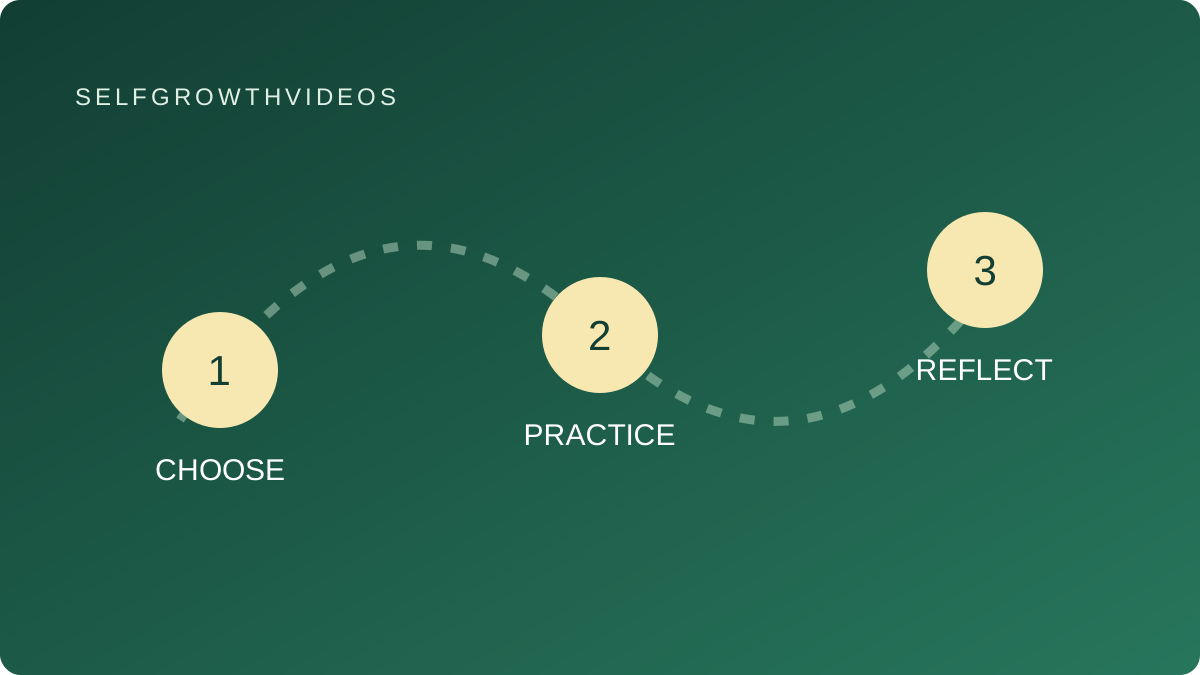 Choose, practice, reflect
A practical learning exercise
The Lesson
You have a useful article and want to turn it into a short social post. The AI draft sounds stronger than the original: “can help” becomes “will transform,” an example becomes a universal rule, and a tentative idea becomes a headline that promises results. The wording is fluent, but the meaning has changed.
Sabrina Ramonov teaches AI prompts and automation through her public education site. In her December 2025 carousel automation guide, she presents templates as starting points to adapt and discusses human review for content quality. Her earlier social-media system explanation describes a pipeline that retrieves an article, uses AI to create different kinds of content, and sends material toward publishing. It also cautions beginners that discovering a useful voice and niche takes experimentation.
Those written explanations show why the handoff between creating and publishing matters. A template can move information efficiently while a generated sentence quietly adds something the source never said.
For this learning practice, separate the source, the draft and the decision to publish. A reviewer should be able to see which sentence came from which evidence. A short post needs fewer words than an article, but shortening should not erase the conditions that make its claim accurate.
Imagine a fictional source saying: “In our team’s trial, a checklist helped us notice missing event supplies. We have not tested it with other groups.” A draft saying “This checklist prevents event mistakes” removes the small trial, changes noticing into prevention, and makes a broader promise. A useful revision might say: “Our team used a checklist to spot missing supplies in one event trial. Here are three questions to try when planning your own.”
The stronger version is not automatically the more useful version. Readers need enough context to decide whether an idea applies to them. A qualifier can be the part that makes a post trustworthy.
Review also needs a visible destination and action. Approving wording does not automatically approve every image, account, time or link attached to it. Keep those decisions clear in the publishing process you use.
For AI-agent tool calls specifically, n8n’s current documentation describes a configured review step that pauses a selected tool for approval or denial. This is a product feature with setup requirements. Writing “ask me first” in a draft prompt does not establish that a particular workflow has this control.
Reflection
- Which sentence in my draft makes the largest claim?
- Can I point to the source passage that supports it?
- Did the rewrite remove a condition, uncertainty or attribution?
- What exactly would a reviewer be approving: text alone, or a specific post and destination?
Practice
Original SelfGrowthVideos exercise: source-to-post review. This exercise is our adaptation for learning, not Sabrina Ramonov’s prescribed checklist.
- Use a short piece you wrote or have permission to reuse. For a first practice, use the fictional checklist example above.
- Ask an AI to produce a short draft that preserves the source’s uncertainty and attributes observations accurately. Request drafts only.
- Make three columns on paper or in a document: draft sentence, supporting source passage, and revision needed.
- Check every factual statement. Mark anything with no support as “remove or research.” Check numbers, dates, names, links and result claims separately.
- Rewrite one overstated sentence. Keep the useful idea while restoring its scope.
- Preview the text with its intended image and destination. Check whether the image introduces an additional claim.
- Save a review note stating which exact version is ready and which questions remain. Leave the sample unpublished during the exercise.
An attractive draft is a starting point. The evidence column makes the review concrete.
Review
Compare your initial draft with the reviewed version. What changed in meaning, rather than style? Record one recurring issue you want future drafts to avoid.
At the next check-in, use a different source and see whether the same review questions uncover a new problem. Revise your drafting instructions based on what you actually find.
Go Deeper
- Sabrina Ramonov’s creator profile links her original teaching and selected videos.
- AI for business and agency explores practical operating workflows.
- Make.com AI is an existing automation learning route.
- Wes Roth: write an agent handoff you can review connects a result with evidence and the next decision.