Tina Huang: Test a Small Template Before Sharing It
Turn a small project into a reusable template by defining its inputs, testing expected results and checking whether someone can use a fresh copy.
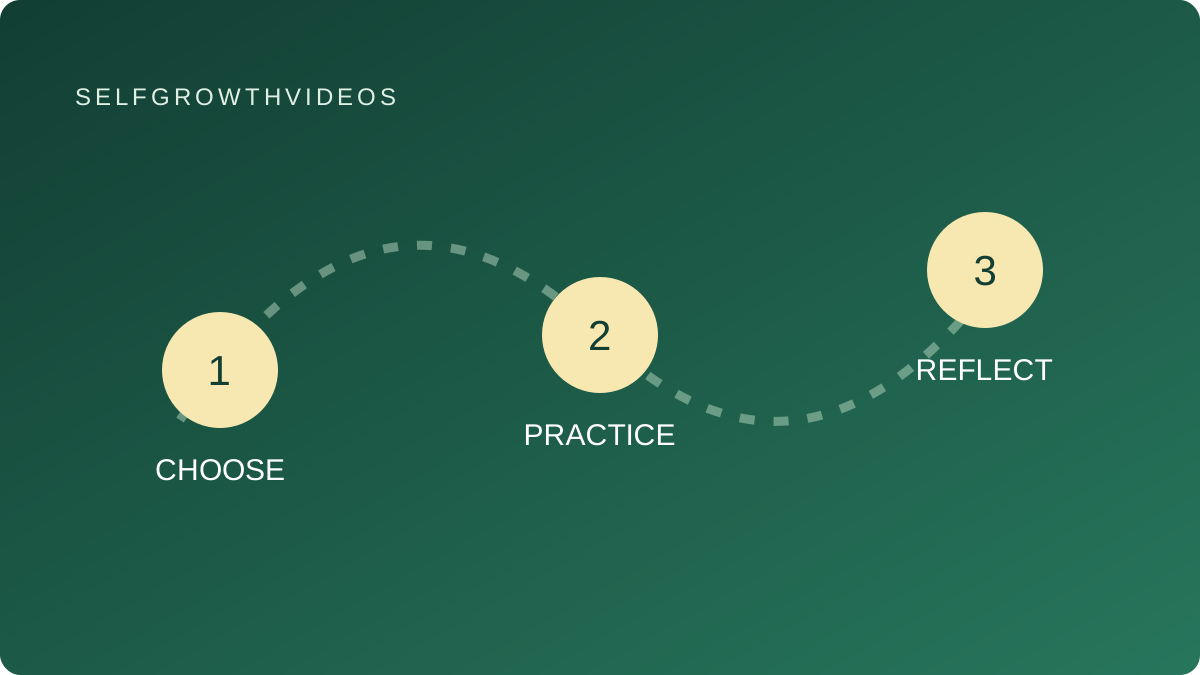 Choose, practice, reflect
A practical lesson
The Lesson
A spreadsheet that works once for its maker may be confusing to the next person. They may not know where to type, what a blank means or which result counts as correct. A reusable template needs an explanation of those decisions as well as a calculation.
In her official article on technical self-study, Tina Huang recommends beginning a project with enough knowledge to start, learning when a problem appears and treating debugging as part of the work. She also emphasizes understanding the logic when AI helps. The official Lonely Octopus site identifies Huang as its founder.
Apply that project approach to something small enough to inspect. Define the result before building it. Then test the saved artifact, including cases where the input is missing or outside the rule you chose. You are learning both how the sheet behaves and what instructions a future reader needs.
The sample below is a workshop materials planner. Its rule is deliberately simple: one pack for each participant plus one fixed demonstration pack. This is a fictional planning assumption, not a general rule for running workshops. The exercise concerns making that assumption visible and checking a reusable file.
Reflection
- Which input should another person change, and what should stay fixed?
- What result do I expect before I build the calculation?
- What should happen when someone leaves the input blank?
- Can I explain the result without relying on an AI answer or my memory?
Practice
Original SelfGrowthVideos exercise: This template trial is our application of learning through a small project. It is not Huang’s template, course exercise or an endorsed product. Use a familiar spreadsheet or begin with a paper prototype.
- Declare the input rule. For this practice, participant count must be a positive whole number. The sheet plans one workshop and adds one demonstration pack. Write both assumptions beside the input so someone can see them without asking you.
- Write expected cases first. Four participants require five packs; six require seven. A blank participant count needs an input, and zero requires a check under this practice’s positive-number rule. Neither should be presented as a completed, valid materials plan.
- Build one small version. Label the participant input and the total-packs output. Keep the fixed demonstration-pack assumption visible. Choose a way to flag missing or unacceptable input in the tool you know. If you have not implemented a check, record it as an unresolved task rather than claiming the template handles it.
- Explain the logic. Describe in plain words how a valid participant count becomes a pack count. If AI helped draft a formula or layout, inspect and test the actual result. An explanation from a tool is a proposal until it agrees with the rule and the cases you wrote.
- Run the saved version. Try each expected case and record the observed result beside it. If a blank produces a plausible number, revise the sheet or its instructions and repeat that case. Add a negative or fractional count as a further challenge to the declared rule.
- Prepare a fresh-copy handoff. Keep an untouched master and make a separate trial copy. Add short instructions covering where to enter the count, what the total includes, what to do with an input warning and how to start another workshop without overwriting the master.
Ask a willing reader to try the fictional four-participant case from a fresh copy using only the instructions. Observe where they hesitate. A question about the demonstration pack suggests an explanation problem; an unexpected total suggests a calculation or input-handling problem. Record the distinction before revising.
Review
Can the reader identify the editable input, explain why the total is five and start again from a fresh copy? Check that your revisions still pass the six-participant and missing-input cases. A clearer label can help a reader while leaving a calculation error untouched, so review both.
Keep a short record of what you tested and what remains uncertain. A few passing cases do not establish that a template handles every input or is ready to sell. They give you a concrete next learning task and a more useful artifact to review.
Go Deeper
Explore Tina Huang’s profile and the separate practice on explaining and changing one generated function. Compare testing an AI interface with one saved result. Find related study in Learning & Career and Digital Products & Resources.