Creator Profile
Alan Watts
Alan Watts (1915–1973) was the single most effective English-language communicator of Eastern philosophy in the 20th century. A British-born former Episcopal priest who became a full-time interpreter of Zen Buddhism, Taoism, and Vedanta Hinduism for a Western audience, Watts published over 25 books and delivered thousands of lectures — many of them preserved on tape by his son Mark. The archive has gone through a continuous renaissance every generation since Watts's death in 1973, most recently reaching hundreds of millions of new listeners via YouTube, TikTok, and mainstream podcast adoption.
alanwatts.org25+
Books Published
1000s
Lectures in the Audio Archive
1957
The Way of Zen Published
1915–1973
Lifetime
Video library
Alan Watts videos by theme
The goal is not to dump every video at once. Start with a small guided set, then move into the deeper library once you know which thread you want to follow.
Start here
A guided first pass
These first videos give the page a clear starting point without forcing readers through a long mobile scroll before the rest of the author profile appears.
Pause and orient: Start with the first few videos, then use the next set to decide whether this author deserves a deeper dive. The page should guide the reader, not bury them.
Browse all 7 videos
Find a title, choose a topic, or explore the full collection. Videos may be hosted by the author or by interview and event channels.
7 videos in this collection
No videos match this search. Try a different title or choose all videos.
About Alan Watts
Alan Wilson Watts was born January 6, 1915 in Chislehurst, Kent, England, to middle-class parents his whole life called “ordinary and decent.” He was a precocious reader and, by his teens, was already corresponding with the leading British Buddhists of the era. He published his first short book, The Spirit of Zen, in 1936 at age twenty-one.
He moved to the United States in 1938 with his first wife Eleanor Everett and her mother Ruth Fuller — the latter a prominent American Zen student who would later marry Zen master Sokei-an. Watts was surrounded, from his American arrival onward, by first-generation American Zen teachers and the small circle of serious Western students learning directly from them. He was never formally authorized as a Zen teacher, and he cheerfully admitted this all his life: his role was not to be a Zen master but to translate.
In 1945 Watts was ordained as an Episcopal priest — an unusual move for someone so drawn to Buddhism, but which he explained as an attempt to see whether Christian mysticism could contain the same realizations as Zen. He served for five years as chaplain at Northwestern University and wrote Behold the Spirit (1947), one of the most interesting and least-read books attempting a Christian-Eastern synthesis in the mid-20th century. He left the priesthood in 1950 after his first marriage ended.
He moved to California. He taught at the American Academy of Asian Studies in San Francisco alongside the scholars Saburō Hasegawa and Haridas Chaudhuri, where he was one of Gary Snyder’s teachers. He became — as the 1950s beat generation gave way to the 1960s counterculture — the voice that America discovered when it wanted to know what all this Eastern stuff actually meant.
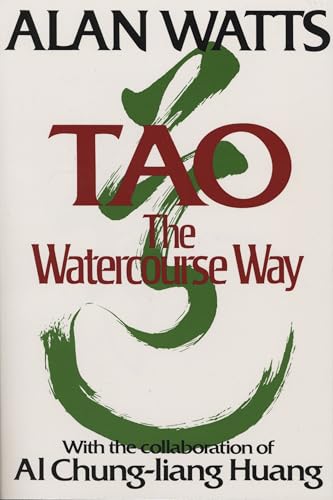
Over the next two decades Watts published The Wisdom of Insecurity (1951), The Way of Zen (1957), Nature Man and Woman (1958), Psychotherapy East and West (1961), The Joyous Cosmology (1962), The Book on the Taboo Against Knowing Who You Are (1966), and — posthumously — Tao: The Watercourse Way (1975). He delivered hundreds of lectures each year: at colleges, at retreat centers, on public-radio station KPFA in Berkeley, and on his Bay Area houseboat. His son Mark Watts recorded most of them.
Watts drank heavily for most of his adult life, and he died of heart failure in his sleep on November 16, 1973 at age 58 in his cabin in Druid Heights, California. He was cremated. Half his ashes were buried at the Green Gulch Zen Center; the other half were scattered near his cabin.
The afterlife of his work has been unlike any other 20th-century teacher. Mark Watts spent four decades digitizing and licensing the audio archive. Watts’s lectures — stripped down, layered over ambient music, or clipped into short excerpts — have reached audiences his living career never could have imagined. A fifteen-second Watts clip about “playing the game” now routinely surfaces in TikTok algorithmic feeds for teenagers born forty years after his death.
His central teaching, compressed: the separate self is a convention, not a reality. You are not a thing in the universe — you are something the universe is doing, the way a wave is something the ocean is doing. Life is not a problem to be solved. It is a game, a music, a dance. The effort to cling to security is itself the thing that makes life feel insecure; the effort to capture pleasure is itself the thing that makes it slip away. The way out is not through — it is noticing that the trap was never real.
Books by Alan Watts
4 titles
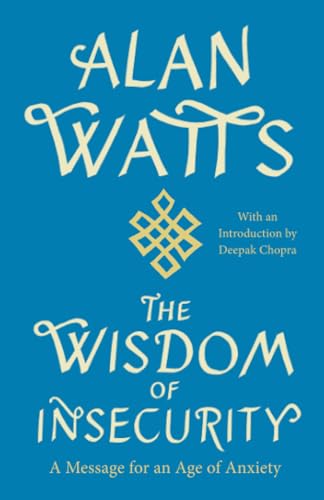
The Wisdom of Insecurity
A Message for an Age of Anxiety
Watts's 1951 breakthrough — a short, direct argument that the anxious pursuit of security is itself the thing that makes modern life feel so insecure. The best entry point to his thinking.
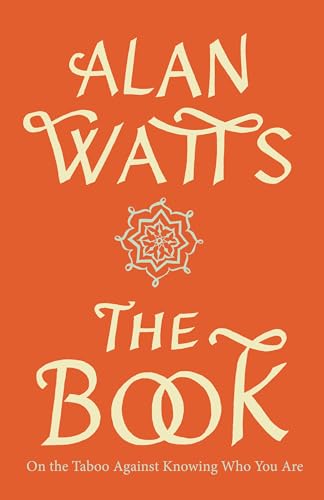
The Book on the Taboo Against Knowing Who You Are
The Book About the Self You Can't Know
Watts's 1966 attempt to explain — in plain English for an American audience — the Hindu-Vedantic teaching that the separate self is a cultural convention layered on top of a fundamentally non-dual consciousness.
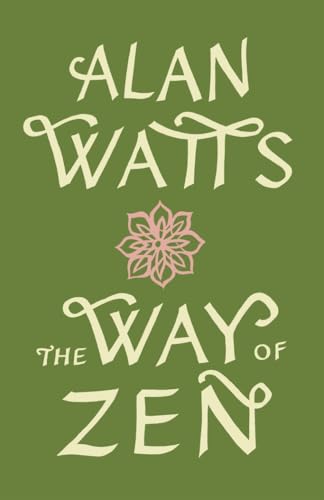
The Way of Zen
The classic introduction to Zen for the Western reader
Watts's 1957 systematic introduction — historical, philosophical, and practical — to Zen Buddhism. The book that put Zen into the American intellectual conversation and has remained the standard starting point for sixty-plus years.
Some links on this page are affiliate links. As an Amazon Associate I earn from qualifying purchases. How affiliate links work here
Resources
Recommended resources
Official
Alan Watts Organization (Mark Watts's archive)
Official
Explore resource →
Archive
Essential Lectures Collection
Official
Explore resource →
Some links on this page are affiliate links. As an Amazon Associate I earn from qualifying purchases. How affiliate links work here